
Population: BIPOC
 Ayuda
Ayuda
 Ayuda
AyudaEIN: 52-0971440
Mission Statement
Ayuda advocates for low-income immigrants through direct legal, social and language services, training and outreach in Washington, D.C., Maryland, and Virginia.
Program Summary
Ayuda provides legal, social, and language services for low-income immigrants including individuals and families affected by immigration challenges, domestic violence, sexual assault, human trafficking, and family separation, ensuring access to justice and support for vulnerable communities.
Impact Statement
For over 50 years, Ayuda’s expert team has helped over 150,000 immigrants navigate complex legal systems and access vital services. With offices in DC, Maryland, and Virginia, we offer both in-person and virtual services to reduce barriers. We also provide emergency financial, food, and material assistance to those in crisis, ensuring immigrants have the support they need to build safe, stable lives.
In 2024, Ayuda provided 3,109 low-income immigrants from 84 countries with immigration legal services, domestic violence, and family law services, comprehensive case management, and/or therapy. 165 language experts contributed to our interpreter bank, accessible to 118 nonprofits, allowing them to break down language barriers as they support clients. Over $228,000 in financial assistance, 21,400 pounds of diapers, and 2,800 pounds of food were distributed to help new immigrant families thrive.
What ways can the public get involved?
There are different ways to get involved with Ayuda. Visit https://ayuda.com/get-involved/ to learn more and support our mission by:
- Joining our mailing list
- Donating to Ayuda
- Fundraising for Ayuda
- Becoming a pro bono partner
- Interning with us
- Attending an Ayuda event
- Joining our growing staff
How are charitable dollars spent? Where does my donation go?
Donations to Ayuda help us provide vital immigration legal services, offer compassionate case management, extend a helping hand through mental health services, and bridge the language gap for low-income immigrant families in the DMV area.
- $10 will provide public transportation for a human trafficking survivor to travel to her new job.
- $50 will provide group therapy support for survivors of domestic violence.
- $100 will provide legal consultation for a low-income individual fleeing violence in their country of origin.
- $200 will cover the legal fees for the immigration case of an immigrant child to remain in the United States safely.
Information provided March 2026
National Coalition of 100 Black Women, Inc., Northern Virginia Chapter
 National Coalition of 100 Black Women, Inc., Northern Virginia Chapter
EIN: 54-1366159
Mission Statement
Our mission is to advocate on behalf of Black women and girls to promote leadership development and gender equity in the areas of health, education and economic empowerment.
Program Summary
The Northern Virginia Chapter, chartered with 35 members on January 22, 1984, in Arlington, VA, under the leadership of the late Mrs. Evelyn Reid Syphax, is committed to improving the quality of life of Black women and girls in the Northern Virginia area. The chapter is a 501(c) 3 advocacy organization dedicated to leadership development, political awareness, and enhancing career opportunities through networking and local programming. NCBW-NOVA addresses critical education, health, economic empowerment, and public policy dimensions.
Education: NCBW delivers support services that help youth achieve their educational goals. By supporting positive experiences, fostering a positive self-perception and self-respect, encouraging excellence in education, and promoting the pursuit of positive lifelong goals, NCBW is creating future leaders.
Health: Health is a vital component of a thriving community. The National Coalition of 100 Black Women, Inc. is concerned about the well-being of the whole community and the whole person physically, emotionally, and spiritually. Our primary focuses for health advocacy are Family and childhood Obesity, Cancer/Health Disparities, and Metabolic Disease.
Economic Empowerment: The National Coalition of 100 Black Women, Inc. views economic empowerment as critical for a just society. We define economic empowerment as the ability to self-determine dreams, pursue and realize them by establishing the mechanisms to sustain generational wealth. NCBW’s programmatic initiative “Sisters-Nomic$” promotes economic self-sufficiency through financial literacy, family wealth building, and entrepreneurship.
Public Policy: As the premier advocacy organization in Northern Virginia for Black women and girls, we have hosted the Annual Luncheon Advocacy Forum for nearly forty years to bring critical issues to our community. Through moderated discussions with thought leaders and trailblazers across various fields, the Northern Virginia Chapter has generated a dialogue amongst our attendees so that they leave the event with ways to impact their local communities. Chapter members serve on local boards, and we meet with local officials, the League of Women Voters, and Housing Authorities to address local policies that impact Black women and girls, their families, and local communities.
Impact Statement
NCBW NOVA Chapter serves the Northern Virginia communities of Arlington County, VA, City of Alexandria, VA, and Fairfax County, VA. As our impact continues to affect the population served, each of our initiatives makes focused impact:
Educational impacts are to: Eliminate disparities Improved outcomes and graduation rates Provide vocational/college preparation courses Provide S.T.E.A.M. (Science, Technology, Engineering, Arts, Mathematics) Education Support HBCU (Historically Black Colleges & Universities) Access Affordability.
Health impacts are Childhood and Family Obesity Initiative NCBW Cancer Health Disparities Program NCBW Metabolic Syndrome Initiative Prevention/Decrease Mortality Improve Health Outcomes Access to Affordable Healthcare Culturally Competent Research Quality of Life – Public Safety and Crime.
Economic Empowerment impacts are: Pay Equity African American Woman-Owned Business Growth Livable Wage Employment Opportunities.
Public Policy impacts are Voter Education/Rights Civic Engagement Increase Women Candidates Running for Political Office, Issue Timely Policy Alerts, and Issue Position Papers on Public Policy Platform Issues.
What ways can the public get involved?
The public can get involved in our programmatic areas by attending listening sessions, responding to call to action alerts, e.g. voter registration, civic engagement and community organizing.
How are charitable dollars spent? Where does my donation go?
All monetary and in-kind donations matter and help to support our ongoing programmatic initiatives. Charitable dollars are spent as the NCBW NOVA Chapter hosts more than twenty various activities and events each program year. Those activities include workshops on financial literacy, wealth building, leadership training and Board member development, Town Halls, webinars, and leading our robust young girls mentoring program.
Information provided January 2025
Legal Services of Northern Virginia
 Legal Services of Northern Virginia
EIN: 54-1137931
Mission Statement
To provide access to justice for disadvantaged individuals and communities.
Program Summary
LSNV provides free legal help to Arlingtonians who cannot afford a lawyer by providing services in a variety of substantive civil legal areas, including: family law/domestic violence, housing law/eviction prevention, consumer protection, elder law, public benefits claims, access to health care, child advocacy, and AIDS/HIV issues. Staff and volunteers provide legal advice, brief service, and representation in administrative hearings and in court, as well as community legal education, and advocacy before local and state governmental entities, all without charge to our clients.
What ways can the public get involved?
Volunteer. Every year we work with hundreds of volunteer lawyers and paralegal who help us extend our reach and serve more clients.
Financial support.
How are charitable dollars spent? Where does my donation go?
Donations go to direct services; helping a survivor of domestic violence obtain a protective order and escape the cycle of abuse; helping a low-income family avoid eviction and stay in their home; helping a low-income veteran obtain the benefits that he is entitled to after decades of services; and many other types of cases which impact basic needs.
Information provided March 2026
Center for Youth and Family Advocacy (CYFA)
 Center for Youth and Family Advocacy (CYFA)
EIN: 82-4681676
Mission Statement
CYFA expands educational opportunity, cultivates growth and resilience, and activates youth leadership and community contribution.
Program Summary
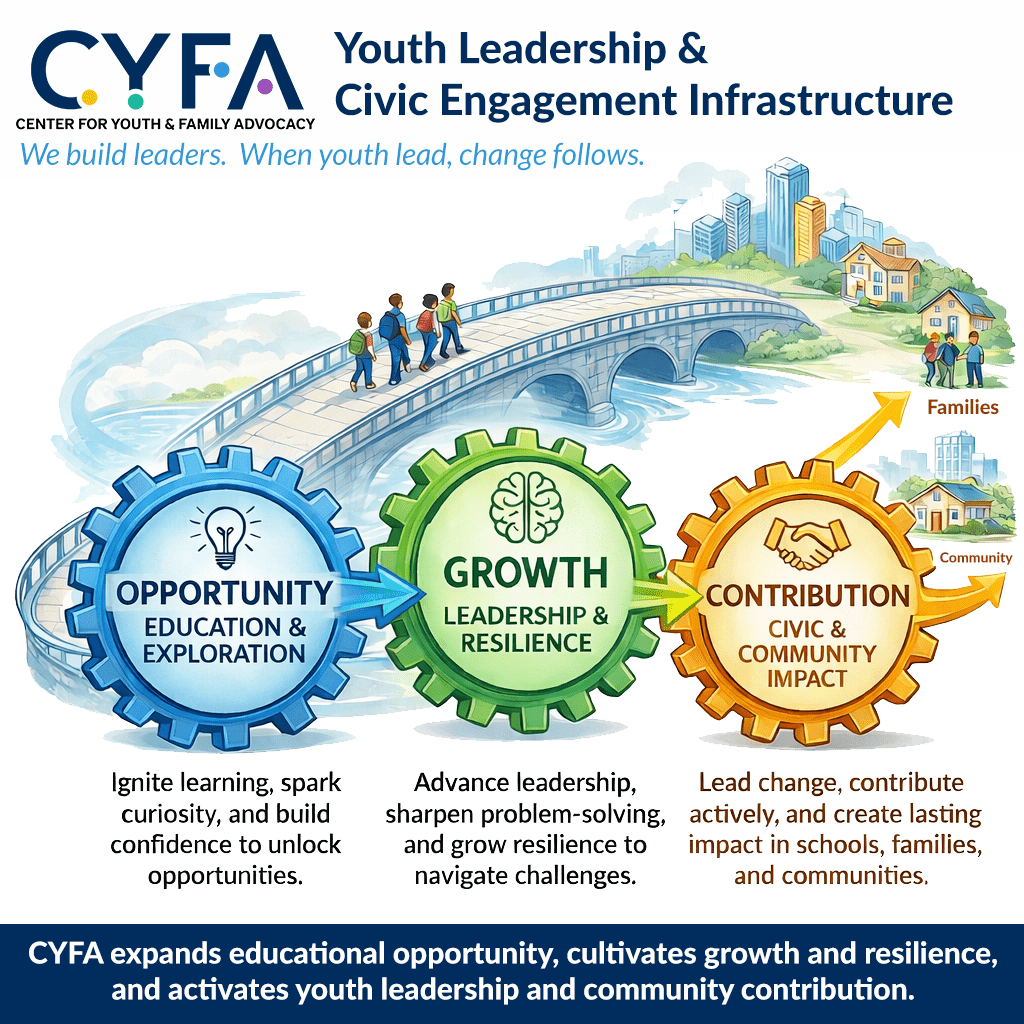
The Center for Youth and Family Advocacy (CYFA) expands educational opportunity, cultivates growth and resilience, and activates youth leadership and community contribution. Across Arlington, CYFA is building the infrastructure that ensures young people have access to opportunity, support, and pathways to lead.
CYFA’s work reflects a clear progression. Through Guiding Personal Success (GPS), youth access opportunity in safe, engaging environments, including The Zone for elementary students and Guiding Personal Success to Youth Employment Services (GPS2YES) for middle and high school youth. CYFA delivers these programs in Arlington Public Schools and in partnership with Affordable Homes and Communities, providing academic support, social-emotional learning, and opportunities to build healthy minds, healthy bodies, and healthy relationships, along with college and career exploration.
As youth grow, they develop accountability and leadership through the Youth Restorative Diversion Initiative (YRDI), a community-based alternative to the juvenile justice system where young people take accountability and repair harm through restorative practices, including PEER and Youth Peer Court (YPC), with advanced leadership through Youth Peer Court Ambassadors.
Youth then step into contribution. Through The Next Chapter, CYFA supports youth in the Northern Virginia Juvenile Detention Center and through reentry, connecting them to education, workforce opportunities, and community resources. Through the Justice Leadership Club and CYFA’s Youth Advisory Board, youth lead and create meaningful change.
Impact Statement
CYFA’s work ensures that young people have access to opportunity, develop the skills and resilience to navigate challenges, and step into leadership within their communities. Through consistent, relationship-based support, youth remain engaged in school, strengthen decision-making and accountability, and build pathways toward college, careers, and long-term stability.
In 2025, CYFA served more than 320 youth, reaching hundreds of family members through engagement and connection to resources. In 2026, 100 teens participated in CYFA’s youth-led Listen Learn Lead Summit, demonstrating the power of youth leadership in action. Across afterschool programs, 60 young people are actively engaged in academic support, social-emotional learning, and skill-building.
Through the Youth Restorative Diversion Initiative (YRDI), CYFA provides a community-based alternative to the legal system, with 99% of youth successfully completing the program and 9 in 10 avoiding deeper system involvement. Every $1 invested in YRDI returns $8 in social value.
Through reentry and leadership pathways, youth not only stay connected to opportunity, but contribute to their schools and communities, strengthening the broader Arlington community.
What ways can the public get involved?
Community members can stay informed through CYFA’s newsletter and Instagram, learning more about our work and the ways we support youth and families across Arlington. Sharing CYFA’s work and using your voice to raise awareness helps expand opportunity for young people.
Financial support is critical to sustaining CYFA’s programs, including educational opportunity through Guiding Personal Success (GPS), restorative diversion through YRDI, and youth leadership initiatives.
There are also opportunities to give your time. Volunteers can support events such as the Listen Learn Lead Summit and other youth engagement activities.
You can also help connect young people to leadership opportunities by sharing pathways to get involved, including the Youth Advisory Board and Youth Peer Court and PEER Ambassador roles.
How are charitable dollars spent? Where does my donation go?
Your donation to CYFA directly supports programs that expand opportunity, strengthen resilience, and build youth leadership across Arlington.
Contributions sustain Guiding Personal Success (GPS), including The Zone and GPS2YES, which provide academic support, social-emotional learning, and opportunities for young people to build healthy minds, healthy bodies, and healthy relationships while exploring college and career pathways.
Your support also powers the Youth Restorative Diversion Initiative (YRDI), including PEER, Youth Peer Court (YPC), and Youth Peer Court Ambassadors, which provide restorative, community-based alternatives that help young people take accountability, repair harm, and stay connected to school and opportunity.
Donations fund The Next Chapter, supporting youth in the Northern Virginia Juvenile Detention Center and through reentry with education, workforce readiness, and ongoing guidance, as well as leadership opportunities like the Youth Advisory Board, Justice Leadership Club, and youth-led events such as the Listen Learn Lead Summit.
Additional support makes community-based experiences like Unplugged possible, creating safe spaces for connection, well-being, and positive peer engagement.
Together, your investment ensures young people have the support, relationships, and opportunities they need to grow, lead, and contribute.
Information provided March 2026
Habitat for Humanity of Washington, D.C. & Northern Virginia
 Habitat for Humanity of Washington, D.C. & Northern Virginia
EIN: 52-1589700
Mission Statement
Habitat for Humanity of Washington, D.C. & Northern Virginia’s (Habitat DC-NOVA) mission is to reduce poverty and housing instability in the national capital area by creating and preserving decenter, affordable, and energy-efficient homes for Washington, D.C., and Northern Virginia residents with low to moderate incomes.
Program Summary
Habitat DC-NOVA believes that everyone deserves a safe, decent place to live. We work to break down barriers to homeownership and help families create stability and intergenerational wealth through permanent housing.
Homeownership: Habitat provides unique opportunities for families with low to moderate incomes to buy their first home. We build quality homes and partner with DC & NOVA families to sell them below market value with affordable financing, reduced down payments, and mortgage payments proportional to income. We serve families earning 30-80% of the Area Medium Income (AMI) and who live in Arlington County, Fairfax County, The Cities of Alexandria, Falls Church, Fairfax, and the District of Columbia.
Home Repair: We partner with seniors with lower incomes and adults with disabilities to help them make critical repairs and accessibility modifications to their homes. By helping families who cannot afford these repairs, we’re helping to make their homes safe, healthy, and supportive of aging in place. With modifications and support, they can continue to live—and thrive- in their own homes and communities.
Impact Statement
For the last 35 years, Habitat DC-NOVA has partnered with families to help them build stronger foundations for their future. Currently, 1/3 of households in our region pay more than 30% of their monthly income towards housing. With many spending a large portion of their income on housing, they have to make difficult decisions between spending on housing, healthcare, food, and transportation.
We have built over 300 homes, completed over 235 home repairs, and served almost 2,000 individuals. In 2018, we found that 52% of homeowners pursued higher education, and 92% of children in Habitat homes had graduated high school.
We have set an ambitious goal to serve 1,000 people by 2030 through our homeownership and home repair program. Active construction is going on in Arlington at Reeves Farmhouse, in DC at 55th Street, and in Fairfax at Fairfax Presbyterian Church.
What ways can the public get involved?
Habitat DC-NOVA brings people with all different backgrounds together to eliminate poverty housing and build community alongside our neighbors needing a decent place to live. We believe everyone can make a difference with their unique skills and talents, and we offer a variety of opportunities to support our affordable housing mission.
Whether you want to swing a hammer, help bring in donations at the ReStore, hold a fundraiser to support our builds, plan an event to raise awareness of housing needs or advocate for housing policies, we have an opportunity that will fit your needs.
Volunteering: We have volunteer opportunities on our construction site, our ReStores, and in our office. Learn more at https://www.habitatdcnova.org/get-involved/volunteer/
Donate home goods, furniture, or construction materials to the ReStore. We have three ReStores (Alexandria and Chantilly) open to the public Monday-Saturday. Shop the store that helps build homes! We accept donations at the store and may be able to pick up larger items at your home. Learn more at https://www.habitatdcnova.org/restore/
Donate your vehicle, motorcycle, or RV to the Habitat for Humanity Cars for Homes program. Your vehicle can help support local families in building strength, stability, and shelter. Learn more at https://www.habitatdcnova.org/support-us/donate-your-car/
How are charitable dollars spent? Where does my donation go?
Habitat DC-NOVA provides decent, affordable homes to families needing a safe place to call home. Each donation is used responsibly to support programs, serve families, and build more equitable and accessible communities in our region. We are currently ranked as a 4-star charity on Charity Navigator, with a 94% ranking.
With the continually increasing cost of building materials and land, we work hard to build partnerships to reduce these expenses. However, significant costs for materials, site preparation, and other services are still needed to serve families in our area.
Information provided March 2026
Neighborhood Health
 Neighborhood Health
EIN: 54-1849891
Mission Statement
Our mission is to improve health and advance health equity in Alexandria, Arlington, and Fairfax by providing high quality primary care regardless of ability to pay.
Program Summary
Neighborhood Health provides accessible, high quality, and patient-centered primary care to patients in Arlington, the City of
Alexandria, and Fairfax County. Our comprehensive model of primary care includes family medicine, internal medicine, and pediatrics as well as dental care, behavioral health, laboratory services, medication assistance, pediatric vision services, HIV care, diabetes education, and medical and non-medical case management. We are accredited by the Joint Commission and a certified Primary Care Medical Home, coordinating care across the health care continuum. Our mission is to improve health and advance health equity in our service area by providing high quality primary care regardless of ability to pay. Our vision is that everyone in our community has the highest quality healthcare and the opportunity to attain their highest level of health.
Neighborhood Health operates two clinics in Arlington; one at the Sequoia complex that serves adults and the Arlington
Pediatric Center which joined Neighborhood Health in January 2024. Many Arlington residents receive care at Neighborhood Health clinics in other jurisdictions.
Impact Statement
Neighborhood Health provides care for low-income, underinsured and uninsured individuals in Arlington County, the City of Alexandria, and Fairfax County. We ensure access to high quality, comprehensive primary healthcare regardless of ability to pay.
In 2024, we served 42,703 pediatric and adult patients. Most of our patients are either uninsured (37%) or on Medicaid (48%). 98% of patients report income of 200% FPL or lower. Over 90% identify as a racial or ethnic minority. We are the largest safety net health provider in Northern Virginia. Our patients have few other options to receive care.
In 2024, Neighborhood Health provided care to over 6,500 Arlington residents.
Neighborhood Health was recognized by HRSA with these 2024 Community Health Quality Recognition awards: Silver Health Center Quality Leader (top 11-20%), Health Disparities Reducer, Access Enhancer, Addressing Social Risk Factors, and Advancing HIT for Quality.
What ways can the public get involved?
The best way to support Neighborhood Health is through a financial contribution.
Neighborhood Health has limited volunteer opportunities. Email nhojvat@nhnva.org with questions.
Neighborhood Health has limited capacity for accepting donated goods. Email nhojvat@nhnva.org with inquiries.
If your organization is interested in partnering with Neighborhood Health, email jknops@nhnva.org.
How are charitable dollars spent? Where does my donation go?
Given Neighborhood Health’s high percentage of uninsured patients – about 37%, we welcome the financial support of individuals, corporations, and foundations to help cover the costs of serving our uninsured neighbors. Donations are used to pay for the care of these uninsured patients.
Examples of What Your Donation Will Cover:
- $5,000 – supports care for 4 uninsured patients with diabetes for a year
- $2,000 – supports the preventive dental care of 2 patients
- $1,000 – supports medical care for 1 newborn for a year
- $750 – supports medical care for 1 uninsured adult patient for a year
- $500 – supports two medical visits for an uninsured patient with heart disease
- $350 – supports two behavioral health visits for an uninsured patient with depression
- $250 – supports a comprehensive dental exam for a new uninsured patient
- $150 – supports an optometry visit for vision screening for an uninsured child
- $100 – supports navigation to specialty care for one uninsured patient
- $50 – supports application of dental sealant for 1 uninsured child
Call (571) 457-9146 or email development@nhnva.org with questions about donations.
Donations to Neighborhood Health can be designated for General Operations or for a specific purpose or project within our scope of work. Donations can also be made in memorium or in honor of an individual chosen by the donor. Please email development@nhnva.org for more details.
Donations to Neighborhood Health are tax deductible as allowed by law.
Information provided March 2025
Britepaths
 Britepaths
EIN: 52-1596259
Mission Statement
Britepaths provides short-term safety-net services to our neighbors in need while empowering them to work toward long-term self-sufficiency. We deliver our services with respect, compassion, and equity, always preserving the dignity and self-esteem of our clients.
Program Summary
Britepaths brings personal finance classes and career building skills to partners in Arlington: Bridges to Independence, ACH Inc., Arlington Agency on Aging, Catholic Charities, ECDC African Community Center, Enterprise Development Group, and Melwood. Clients participate in a series of classes that vary with the needs of each partner and have options for further one-one-one financial empowerment and/or career building services. Arlington residents who have low or middle incomes are welcome to sign up for any of the free services offered through the Financial Empowerment Center (FEC). The FEC assists over 2,000 individuals annually, providing most services virtually which are offered in English, Spanish, and other languages as needed. Services include personal finance workshops, classes, financial coaching and mentoring, small business and tax consulting, tax assistance, and some legal services. Workforce development programs include workshops, coaching, leadership skills and soft skills training, mentoring, and culinary skills training. The best place for the most recent options is to go directly to the website at https://soco.financialempowermentcenters.org
Impact Statement
Britepaths offers services that actually help improve the lives of families in financial crisis. The services we provide to clients through our Arlington partners, help them to develop tools to organize, understand, and manage their finances. Using these tools, they can start to pay down debt, become banked, and/or start saving. We also help them with job skills to help them find a job or move a better paying one. Any of these skills can help improve their current situation. We encourage clients to explore our other, more long-term services that have proven effectiveness. For clients who attended classes or workshops, 71% of respondents have improved their financial situation, and for clients who participate in financial mentoring for 6-9 months, 81% improve their situation based on survey score. We serve more than 2,000 clients annually through the Financial Empowerment Center (FEC) receiving personal finance and/or workforce development services. We continue to add workforce training and certification classes.
What ways can the public get involved?
The Financial Empowerment Center uses many volunteers. Anyone with a financial background can be trained to be a financial coach, mentor, or instructor. Workforce development needs volunteers to mentor clients in their own field to help them learn more about the field and develop a professional network. We also need volunteers to do practice interviewing and review resumes. We are particularly seeking bilingual volunteers in any language but have a need for Dari and Pashto speakers. We also need office volunteers to help with data entry and calling clients to remind them of scheduled coaching sessions. The best way to find out about volunteering is https://soco.financialempowermentcenters.org/get-involved/ or https://britepaths.org/get-involved/volunteer/
How are charitable dollars spent? Where does my donation go?
Donated dollars go to support the staff time, materials needed for classes and workshops, translation services, and other community needs. The services provided at the Financial Empowerment Center (FEC) are mostly provided by volunteer financial professionals. Staff coordinate classes, coaching sessions, mentor matches, develop curricula for workshops and classes, data entry, and reporting. Workforce Development staff provide coaching, some classes, curricula develop and use professional volunteers for classes and mentoring. Training classes are taught by professional instructors. We provide training materials and in the case of culinary skills training, provide a kitchen and food to prepare. We engage in as many partnerships as possible to stretch donated dollars for maximum impact.
Information provided March 2026
CARE, Inc.
 CARE, Inc.
EIN: 54-1807476
Mission Statement
CARE, Inc. mobilizes partnerships and community leadership to connect people with resources, opportunities, and support systems that strengthen families, enrich lives, and build a more inclusive and economically vibrant community.
We foster trust, cultivate collaboration, and deliver impactful programs that advance education, economic empowerment, and community well-being.
Program Summary
CARE, Inc. (Community Association of Resources, Education, Enrichment & Economics) is a community-rooted nonprofit dedicated to strengthening families and advancing underserved communities.
We serve as a trusted connector—bringing together residents, service providers, local businesses, and strategic partners to build a more equitable, resilient, and thriving community. Through collaborative initiatives, including the Green Valley Farmers Market, we expand access to fresh food, economic opportunity, youth development, and supportive services that uplift generations.
Our work is grounded in relationships, driven by community voice, and focused on creating sustainable systems that support health, stability, and long-term prosperity.
CORE PROGRAM AREAS
🥕 1. Green Valley Farmers Market (Food Access + Economic Development)
- Weekly seasonal farmers market in a historically underserved community
- Increases access to fresh, culturally relevant foods
- Supports local farmers, small businesses, and entrepreneurs
- SNAP/EBT access and healthy food incentives (planned/expanding)
🚲 2. Youth Development & Workforce Pipeline (Ages 10–18)
- Gardening Apprenticeship Program (GAP)
- Financial literacy, entrepreneurship, and job readiness training
- Youth-run market participation (vendors, operations, leadership roles)
- Summer internships and community service engagement
👵🏽 3. Seniors & Aging in Place
- Food access support through market and delivery options (developing)
- Resource navigation for housing, health, and social services
- Community connection to reduce isolation
- Advocacy for affordable housing and aging-in-place solutions
COMMUNITY NEED
- Limited access to fresh, affordable food in historically underserved neighborhoods
- Youth lacking structured workforce development and leadership opportunities
- Seniors facing housing instability, isolation, and barriers to services
- Fragmented service systems that require stronger coordination and trust
CARE addresses these gaps through integrated, place-based solutions that meet people where they are.
Impact Statement
We build community-led solutions that strengthen families, reduce inequities, and create sustainable pathways to opportunity.
🎯 Our Focus Areas
Food Access & Economic Opportunity
Green Valley Farmers Market
- Fresh, culturally relevant food access
- Local vendor & small business support
- Youth entrepreneurship opportunities
Youth Development (Ages 5–10) — Early Foundations Program
- Literacy enrichment & reading engagement
- Social-emotional learning (SEL) & confidence building
- Nutrition education & healthy habits (linked to Farmers Market)
- Creative arts, storytelling & cultural identity
- Safe, structured enrichment in community spaces
Youth Development (Ages 10–18)
- Workforce readiness & leadership training
- Hands-on entrepreneurship (market vendors, internships)
- Mentorship & community engagement
Aging in Place (NEW 2026 Initiative)
- Volunteer caregiving & companionship
- Transportation, meals, and home support
- Reducing senior isolation and housing instability
What ways can the public get involved?
🌿 Public Engagement Strategy for CARE, Inc. Programs
🤝 1. Volunteer Pathways (Entry → Leadership)
Create clear, flexible ways for people to get involved immediately:
Entry-Level (Easy On-Ramp)
- One-day service events (farmers market setup, senior home clean-ups)
- “Bring-a-friend” volunteer days
- Youth + family volunteer opportunities
Ongoing Roles
- Senior companions (“Adopt-a-Grandparent” model)
- Market ambassadors & greeters
- Youth mentors & reading buddies (ages 5–10 program)
Leadership Roles
- Volunteer team leads
- Community captains by neighborhood
- Advisory committee members
🧒🏽 2. Family & Intergenerational Programming
Bring the whole community together—not just individuals.
- “Kids & Seniors Together” days (reading, storytelling, cooking)
- Family volunteer days at the farmers market
- Youth teaching seniors tech basics (phones, apps, telehealth)
- Community gardening days
🥬 3. Community Events as Engagement Hubs
Use events as entry points into deeper involvement
- Green Valley Farmers Market activations:
- Health screenings
- Cooking demos
- Youth vendor showcases
- Seasonal events (Back-to-School, Senior Appreciation Days)
- “Community Care Days” in neighborhoods
🗣 4. Community Voice & Co-Design
Let residents help shape the programs
- Quarterly community listening sessions
- Surveys (paper + QR code at events)
- Youth advisory council
- Senior advisory group
📣 5. Faith & Community Partnerships
Leverage trusted institutions
- Partner with churches for:
- Volunteer recruitment
- Senior outreach
- Space for programs
- Collaborate with schools for youth engagement
- Engage local businesses as sponsors + volunteers
📱 6. Digital Engagement (Simple + Consistent)
Meet people where they already are:
- Monthly email/newsletter: “CARE in Action”
- Social media:
- Volunteer spotlights
- Senior stories
- Youth success highlights
- Text reminders for events and volunteer shifts
🎓 7. Skill-Based & Corporate Volunteering
Tap into professional talent:
- Handymen → senior home repairs
- Accountants → financial literacy workshops
- Chefs → cooking demos
- Corporate teams → service days
🧾 8. Public Recognition & Storytelling
People stay involved when they feel valued
- Volunteer of the Month
- Youth achievement showcases
- Senior stories (“Legacy Voices of Green Valley”)
- Social media + event recognition
How are charitable dollars spent? Where does my donation go?
The majority of funds directly support community programs:
Food Access & Farmers Market
- Fresh food distribution and access initiatives
- Market operations (permits, equipment, logistics)
- Vendor support and small business development
Youth Development (Ages 5–18)
- Educational materials, books, and supplies
- Youth stipends and workforce training
- Mentorship programs and enrichment activities
Aging in Place (Senior Support)
- Transportation assistance and meal support
- Volunteer coordination for caregiving services
- Basic home support (supplies, minor repairs)
CARE, Inc. invests charitable dollars where they matter most—directly into people, programs, and community solutions—while maintaining lean operations and measurable impact. We work mostly with volunteers and pay stipends for our Interns.

Information provided March 2026
OAR of Arlington, Alexandria and Falls Church
 OAR of Arlington, Alexandria and Falls Church
EIN: 54-1024562
Mission Statement
OAR is a community-based nonprofit organization that envisions a safe and thriving community where those impacted by the legal system enjoy equal civil and human rights. Through our Upstream work, we are confronting and dismantling individual racism and racism in the legal system and across all systems. Our Downstream work allows us to be on the journey with individuals of all genders returning from incarceration and their families. We also offer alternative sentencing options (including community service) and diversion programs so people can avoid the trauma of incarceration and instead help the community thrive.
Program Summary
OAR Upstream:
Racial Justice + Liberation
We lift the voices of Black, Indigenous, Latinx/e/o/a, Asian, and Mulitcultural (BILAM) people who have experienced racism and other intersecting forms of marginalization and challenge white people (WP) and those who have benefited from personal and systemic racism to become leaders in dismantling injustice and redressing the harm caused by personal racism. Efforts include facilitating multiple intensive virtual learning cohorts for community members and especially those working in law enforcement and the criminal legal system that address liberation and dismantling whiteness.
OAR Downstream:
Reentry Services
We work with individuals at the Arlington County Detention Facility, the Adult Detention Center in the City of Alexandria, the closest Virginia state prison, and other correctional facilities who are preparing to return to the community and who come back to Arlington, Alexandria, and Falls Church. We also journey with their families before and after release. Our efforts in facilities include pre-release workshops focused on reentry issues, health and wellness, group psychotherapy, and transition planning. After release, we provide direct services (such as housing assistance, clothing, transportation, smartphones, laptops, debt repayment, and ongoing help with rent and other expenses), offer a comprehensive Employment Program, and facilitate an ongoing weekly virtual support group for program participants. OAR also established a pilot, gender-responsive, clinical services initiative providing a range of reentry services specifically tailored for individuals identifying as women/female/femme who are coming home to the community after experiencing incarceration.
Alternative Sentencing + Diversion
OAR works with Arlington County and the City of Falls Church Courts to provide alternative sentencing and diversion programs. OAR’s community service program allows individuals to do volunteer work in the community in lieu of jail time and fines, to work off their accrued court costs, and also pay court costs. OAR is implementing a Diversion program in partnership with the Vera Institute and Office of the Commonwealth’s Attorney – Arlington County and the City of Falls Church with the goal of reducing recidivism as well as racial disparities amongst individuals sentenced to diversion programs. (by 20% each year)
Impact Statement
OAR is a Collective, non-dominant, decolonizing, pro-Black, racially just, radically joyful, deeply loving, come as you are, liberated organization that puts participants first. We center authentic and fully engaged relationships with all members of the OAR community. Our goals include partnering with those who have experienced incarceration so they can create a safe reentry for themselves and preventing other individuals from enduring that trauma through alternative sentencing programs. With our upstream social justice work, we hope to spur the type of pro-Black racial justice activism that will help ensure that no one will need our social services and OAR no longer needs to exist 50 years from now.
How are charitable dollars spent? Where does my donation go?
- $50 – Provides a stipend to a child of an OAR participant impacted by incarceration
- $100 – Provides 1 month transportation/metro fare for OAR participant(s)
- $250 – Cover ID retrieval for OAR participant(s) needed to secure housing
- $500 – Covers up to three months of coaching for an OAR participant(s)
- $1,000 – Provides up to one month of rent for at least an OAR participant(s)
- $2,500 – Provides up to 90 days worth of reentry services for OAR participant(s)

Information provided March 2026