
budget-size: Less than $1M
 Latinas Leading Tomorrow
 Latinas Leading Tomorrow
EIN: 27-5119847
Mission Statement
Our mission is to connect and expose Latinas to opportunities that enrich their future through education, mentoring and leadership development
Program Summary
We are dedicated to empowering Latina middle and high school students through our free programming initiatives. These programs, specifically designed for Latinas leading tomorrow, encompass a range of opportunities. From our CORE (Creating Opportunities to Reach Excellence) program, which lays the groundwork for future success, to our ELITE Leadership Academy, where leadership skills are honed within a supportive team environment, we strive to provide avenues for personal and academic growth. Additionally, our LLT STEMpower Camps serves as a platform for Latinas to excel in these critical fields, equipping them with the skills and confidence to become leaders in STEM and beyond. Through these initiatives, we aim to inspire and empower the next generation of Latina leaders to reach their full potential and make a meaningful impact in their communities and beyond.
Impact Statement
Our organization’s efforts have yielded significant outcomes for the population we serve. Latinas Leading Tomorrow has positively impacted a diverse demographic, with 65% coming from low-income backgrounds, 60% being first-generation students, and 50% raised in single-parent households. Remarkably, 90% of our participants have successfully transitioned to college, showcasing the profound effect of our work.
What ways can the public get involved?
Ways the Public Can Get Involved with Latinas Leading Tomorrow
There are many meaningful ways individuals, organizations, and businesses can support the mission of Latinas Leading Tomorrow and help empower the next generation of young women leaders.
Volunteer with Our Programs and Events
Community members can volunteer their time by supporting student workshops, mentoring sessions, STEM activities, or helping at community events such as our Noche de Impacto celebrations, STEM Boot Camps, and college exposure trips.
Become a Speaker or Mentor
Professionals are invited to share their career journeys and expertise with our students through guest speaking opportunities, career panels, and mentorship sessions that inspire young women to explore new possibilities.
Partner with Us
Organizations, universities, and businesses can partner with LLT to create internships, host educational experiences, sponsor programs, or collaborate on initiatives that expand opportunities for our students.
Make a Donation or Provide In-Kind Support
Financial contributions and in-kind donations such as school supplies, technology, transportation support, or event sponsorships help ensure that our programs remain accessible to the students and families we serve.
Host or Support a Fundraiser
Community members can help raise awareness and resources by organizing fundraising events, sponsoring program activities, or participating in events like our Reach for the Stars 5K or Noche de Impacto celebrations.
Together, we can create more opportunities for young women to grow as confident leaders, pursue higher education, and shape the future of our communities.
How are charitable dollars spent? Where does my donation go?
Latinas Leading Tomorrow allocates $0.89 to $1 of each dollar towards programming, directly supporting mission-related activities and services. Here’s a detailed breakdown:
Programming Expenses: This part of the budget covers essential activities and services that fulfill the organization’s mission. For instance, it includes expenses for program materials like T-shirts and educational materials, as well as provisions for meals/snacks and transportation for field trips. Additionally, it covers costs for a program coordinator to oversee operations.
Administrative Costs: Administrative expenses pertain to the overall running of the organization and include expenditures like rent for storage space and dues & subscription expenses.
Fundraising Expenses: Funds dedicated to fundraising cover various costs associated with generating additional financial support for the organization’s mission. This encompasses expenses related to events like 5K Run/Walk, marketing and advertising efforts, donor outreach, and engaging a race timer.
Information provided March 2026
Culpepper Garden
 Culpepper Garden
EIN: 54-1681671
Mission Statement
Culpepper Garden, owned by the nonprofit Arlington Retirement Housing Corporation, is a nonprofit retirement community providing 346 affordable living apartments with services for low-income older adults over age 62. Our mission is to provide and advocate for high quality, affordable housing, services, and care that helps older adults on fixed and low incomes to age with comfort and dignity. Our affordable, assisted living wing was the first in the nation to provide federally subsidized housing plus care and we are still the only one in Arlington today. We are committed to providing a continuum of care for generations to come.
Program Summary
Culpepper Garden is a community of care featuring 346 independent and assisted living apartments in Arlington, Virginia, designed to serve at-risk older adults.
Independent Living
Our independent living features 273 one- and two-bedroom apartments for residents who want to live with as much autonomy as possible. Residents enjoy daily dining service from our on-site kitchen, housekeeping services, and regular maintenance of their home. Easily accessible, on-site amenities that include a library, computer room, free Wi-Fi, hair salon, outdoor walking paths, and free parking enhance community life at Culpepper Garden. All residents receive substantial income-based rent subsidies from HUD to ensure their housing remains affordable.
Assisted Living
Our 73-unit assisted living wing is available to residents who need help with activities of daily living. The first facility of its kind in the country to receive federal rent subsidies, Culpepper Garden’s assisted living residence serves as a national model for quality specialized housing and care for older adults who need it the most. Residents in assisted living receive assistance with medication management, daily meals prepared by our Dining Services, assistance with bathing and dressing and access to a licensed nurse on staff. A full-time active life enrichment staff person leads five to eight resident programs and entertainment each day.
Impact Statement
Culpepper Garden’s mission-driven work focuses on key goals including ending and preventing homelessness among the older adult population, meeting the unmet and changing needs of our marginalized seniors, and fostering residents’ individual dignity, autonomy, and wellbeing. Last year, we were the sole safety net for nearly 400 low to extremely low-income older adults, a majority of whom earn an average monthly income of $1,300 or less and in no other instance could afford to age in place in Arlington County. With generous donor support, in FY24 we were able to provide care subsidies for 41 vulnerable assisted living residents who could no longer pay for their care. Since opening our assisted living wing 24 years ago, we have never stopped caring for anyone. Assisted Living Subsidies, made possible through support from Arlington County and private donations, has enabled 100% of our charitable residents to date (233 individuals) to age in place in Arlington with a high quality of life.
What ways can the public get involved?
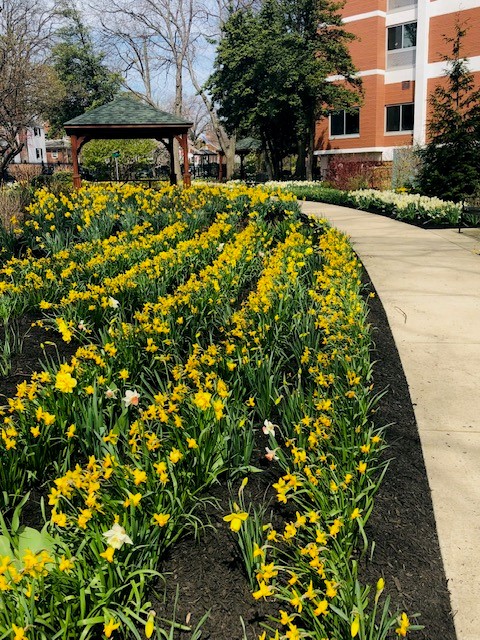
Volunteer. Our organization could not do this important work without the dedicated, passionate volunteers who serve Culpepper Garden. Volunteers assist with maintaining our gardens and grounds, assisting with special events, leading resident activities, and more. By volunteering here, you will be joining others in our community who are making a positive difference.
Donate. Almost all of the funding we receive from donors goes to direct services and care subsidies for our residents. We are extremely efficient in how we use the money we have.
Collaborate. We regularly seek out opportunities to partner with local organizations and supporters who compliment and advance the impact we are able to make in our community. We’ve been able to sustain our work for nearly 50 years because of our lasting partnerships
How are charitable dollars spent? Where does my donation go?
We believe that everyone should be able to live out the last years of their life with dignity. Culpepper Garden is uniquely positioned to provide a community of care to at-risk older adults. As a resident’s care needs increase, the level of care required also increases. Yet, Assisted Living care is costly even in an affordable community like ours. That is why we rely on donor support to aid us in assisting our most frail and vulnerable residents who have outlived their assets and can no longer afford their cost of care. Your donation will support financial subsidies that offset the cost of assisted-living services and care for our lowest-income residents with the greatest need and enable them to continue leading their dignified lives. With your support, we can assure that no resident, no matter how vulnerable or low income, will ever have to leave Culpepper Garden Assisted Living because they can no longer afford their care.
Information provided March 2025
National Chamber Ensemble (NCE)
 National Chamber Ensemble (NCE)
EIN: 46-4007072
Mission Statement
The Mission of the National Chamber Ensemble (NCE) is to entertain as well as provide opportunities to appreciate and enjoy the art of chamber music, bringing together performers, audiences and composers. The NCE produces high quality chamber music performances for the general public at a reasonable cost. Through our performances and commissions of original musical works we present a full range of chamber music repertoire from the classics to the contemporary. The most important goal of the NCE is to build a sense of closeness between performers and audience that enhances the feeling of community and a deeper musical experience.
How are charitable dollars spent? Where does my donation go?
Contributions are tax deductible to the fullest extent of the law. They support educational programs NCE produces as well as general operation support such as printing, piano movers, piano tuners etc. They may help with special projects involving guest artists.
Information provided March 2025
Four Mile Run Conservatory
 Four Mile Run Conservatory
EIN: 81-1611867
Mission Statement
The Four Mile Run Conservancy connects nature, culture, and community at lower Four Mile Run through restoration, advocacy, recreation, and education.
Program Summary
COMMUNITY STEWARDSHIP: we provide frequent opportunities for volunteers to improve the condition of lower Four Mile Run, such as land- and kayak-based litter clean-ups, native tree/shrub plantings, and invasive species removal.
YOUTH AND PUBLIC PROGRAMS: through our Nature Explorers And Restorers (NEAR) program, we offer outdoor learning opportunities for young people, mostly those from program partners that serve recently-immigrated families, families transitioning from homelessness, and underserved youth. NEAR programming is provided at no cost to them. Throughout the year we offer public interpretive programs, such as pop-up nature centers and park walks highlighting nature and local history.
CONSERVATION INTERNSHIPS: we offer part-time paid summer internships for high-school and college age youth, providing on-the-job experience in natural resource management, field research, and program leadership.
COMMUNITY SCIENCE: we conduct ongoing research with community volunteers and youth interns that includes wildlife camera surveys, water quality testing, and documentation of the ecosystem using the iNaturalist app and online mapping tools.
PARK IMPROVEMENT: we advocate for and seek out resources to support better park infrastructure. Projects have included signage, public drinking water sources, bird nesting boxes, and our current project to build an ADA-accessible kayak and canoe launch.
Impact Statement
We see lower Four Mile Run, its associated park lands, and surrounding community as extraordinary in ecological and socioeconomic diversity, as well as in the range of activities that happen here, whether organized sports, outdoor recreation, informal play, fishing, picnicking, and more. The area’s demographic diversity is reflected in our volunteers, who come from the immediate neighborhood as well as from all across the DC metro region.
We continue to work to ensure the benefits of nearby nature are accessible to the community, both in terms of addressing physical barriers, as with our recently completed project to build an ADA-accessible public kayak/canoe launch, and in terms of sociocultural barriers, as with translation of signage and interpretive materials.
As we celebrate our 10th anniversary this year, we reflect on an impact that has included:
- more than 20 tons of litter removed in 265 land and kayak-based clean-ups
- 200+ trees and 300+ wetland plants/shrubs planted
- 56 internships provided for high school and college students
- Construction completion of an ADA-accessible kayak launch
Coming soon: freshwater mussel restoration and adaptive paddling programs!
What ways can the public get involed?
Volunteering for land-based and kayak-based stream/park clean-ups, planting, and invasive plant removal events, participating in our local nature/history walks, visiting our pop-up nature centers and tables at local events.
How are charitable dollars spent? Where does my donation go?
Donations support project and program expenses. We do not receive County or City funding, and depend on donations and grants to support our work.

Information provided March 2026
Equipment Connections for Children
 Equipment Connections for Children
EIN: 27-1062106
Mission Statement
ECFC connects with families of children living with disabilities in order to help fulfill vital unmet adaptive equipment needs, provide educational workshops, and foster community, free of charge.
Program Summary
Our equipment loan closet helps provide needed equipment to families struggling to get the equipment their child needs, either at all or in a timely manner. Families can use the equipment as long as needed. When the items are returned, they can then go out to another family in need!
Impact Statement
We have helped thousands of families with children living with disabilities in Maryland, DC, and Northern Virginia since 2009.
How are charitable dollars spent? Where does my donation go?
All donations go to support our equipment loan closet program.
Information provided April 2024
Friends of Clarendon House
 Friends of Clarendon House
EIN: 54-1644438
Mission Statement
In existence since 1992, the Friends is a group of individuals who support Arlington’s mental health programs, especially Clarendon House, and individuals served by Arlington’s Behavioral Healthcare Division.
How are charitable dollars spent? Where does my donation go?
Housing assistance, medical and dental expenses, food pantry, social activities
Information provided March 2026
CARE, Inc.
 CARE, Inc.
EIN: 54-1807476
Mission Statement
Our mission is to provide and serve our clients with resources, education, enrichment and economic opportunities. We do this for the disadvantaged and underserved, primarily serving and mentoring low-income, at-risk youth and families.
We work with community partners and provide them with project/program management and support, fundraising events, technical skills and grant writing.
Program Summary
Our programs and activities include the following:
- Community Learning afterschool programs and summer camps that build collaborations through resources and education for those we serve with opportunities, apprenticeships, classes, workshops and retreats.
- Association of providers who we support and encourage them to support our participants.
- Resources for Parents, Seniors, Ex-Offenders and Youth to support and enrich their lives.
- Education and opportunities through programs like Dinner Chats, Community Gardens and Youth Markets at our Green Valley Farmers Market. We believe in “Teaching Men to Fish and Farm for a Living” to become self-sufficient.
- Enrich the lives of those we serve in underserved communities.
- Economic development opportunities at our Green Valley Farmers Market and Learn to Earn Program, Mobile Food and Concession Stands. We provide opportunities for employment and income through these programs in underserved communities.
- Preserving the history in communities and engaging residents to learn more about how they can enrich their lives and their communities, by understanding their past.
Impact Statement
- Underachievers who attend our programs find purpose and grow up with skills learned for a lifetime of living.
- Parents gain access to resources and programs that can meet their needs. We engage them in community matters as volunteers and resources, helping them to relay their needs and get any help that they need.
- Our programs created to serve youth are now modeled by others and offered in several communities.
- We work with partners and help them to be successful in delivering their programs and activities to those in need.
- Our youth are provided opportunities afterschool and outside of home that can lead them to learn skills and fulfill their goals in life.
- Starting with Gardening for the community we have now connected our Gardening Apprenticeship Program (GAP), Farm to Table and the Green Valley Farmers Market (GVFM) that will provide coupons and encourage healthy eating and wellness through other market activities.
What ways can the public get involved?
CARE is primarily an organization served with volunteers. We look for volunteers that want to share their knowledge and skills to enrich the lives of our program participants. Volunteers are needed to mentor, teach and chaperone. Volunteers works with groups in our gardens and will be helpful in setting up and operating our Farmer’s market and selling goods and services. No specific skills are required, just time and energy. Students in middle and high school can volunteer and participate in GAP and Learn to Earn, while preparing for college.
We always welcome any donations and contributions of resources that we use in our programs and distribute to families in need. We provide family time meals and snacks and refreshments in our programs afterschool and when we meet with parents. Parents can attend Dinner Chats to meet service providers and share their needs.
How are charitable dollars spent? Where does my donation go?
Donations help us to buy and provide school supplies for students, snacks afterschool, meals for family times and programs. For programs we provide supplies that includes arts & crafts, healthy eating and incentives and awards. Awards includes trophy’s, certificates, gift cards and gifts to recognize special achievements and accomplishments.
Student scholarships are awarded to those who want to participate in organized sports, clubs and camps. Sometimes we supplement fees that can be several hundred dollars for a summer camp. Donations help to support our summer and afterschool programs with staffing when needed. Transportation cost for field trips and admissions are needed for those we work with, that cannot afford to pay added cost.
We use space and facilities that sometimes charges us fees and requires us to have insurance to cover any liability issues.
Our programs and support for the communities we serve is based on donations, grants and in-kind services.

Information provided March 2025
Rosie Riveters
 Rosie Riveters
EIN: 47-4710197
Mission Statement
Rosie Riveters, a 501(c)(3) nonprofit, works to close the gaps in today’s workforce by increasing participation in STEM, fostering critical thinking and problem-solving skills to develop the innovators of tomorrow.
Program Summary
Rosie Riveters offers hands-on STEM programs that foster confidence through productive struggle, critical thinking, and problem-solving. Designed for flexibility, its K-8 projects adapt to various settings—whether a 45-minute classroom lesson or a two-hour group experience—making STEM learning accessible in classrooms, military family programs, and community events. The high school program, Rosie Innovators (9-12), builds on this foundation, deepening STEM engagement and preparing participants for future education and careers.
Impact Statement
Since our inception in 2016, we have had the privilege of serving over 20,000 participants, witnessing remarkable outcomes with 96% of our participants enjoying the program and 89% being inspired to further explore STEM.
What ways can the public get involved?
You can get involved with Rosie Riveters in a few impactful ways! Volunteer your time by helping with quarterly STEM programs, packing STEM kits, or supporting events. If you’d rather contribute financially, donations go a long way in expanding programs and reaching more girls. Businesses and organizations can also partner by sponsoring programs, matching employee donations, or getting teams involved in volunteer activities. Want to stay in the loop? Subscribe to our mailing list for updates and event info. However you choose to help, you’ll be making a real difference in inspiring the next generation in STEM https://rosieriveters.org/volunteer/
How are charitable dollars spent? Where does my donation go?
At Rosie Riveters, every charitable dollar goes directly toward providing hands-on STEM experiences for students. Thanks to generous donations, we’ve served over 35,000 participants, giving them the opportunity to build confidence and critical thinking skills through engaging STEM projects. Your support helps fund program materials, STEM kits, educator resources, and expansion efforts to reach even more future innovators. Every contribution makes a tangible impact in inspiring the next generation of women in STEM!

Information provided March 2025
Read Early and Daily (READ)
 Read Early and Daily (READ)
EIN: 82-3345797
Mission Statement
Ensuring babies and young children have new, quality, culturally relevant books of their own that are mirrors and windows into their everyday lives and communities
Program Summary
FACT: All babies are born with the same number of neurons…BILLIONS.
FACT: Neurons are pretty much useless unless they make a connection (aka synapse).
FACT: Connections are made through talking, singing, cuddling, and most importantly, READING books with your baby.
Every time a book is read to a baby, a connection is made in their brain, that is, a neuron is activated (*lit up*). Isn’t that amazing?! It’s that simple.
BUT without books in the home, reading to babies and young children every day is nearly impossible.
- On average, children from low-income families have 1 book compared to 12 books that their peers from middle income families have.
- As a result, these young children hear 25 hours of 1-to-1 reading before school while children from middle-income families hear 1,000 hours of listening to books read aloud.
- By age 3, a child from a low-income family has a listening vocabulary of 500 words, compared to 1,100 for their peers from middle-income families.
- Arriving at school, they score 60% lower on cognitive tests and lag 12-14 months behind in language and pre-reading skills.
READ was created to address reading inequities faced by Arlington’s youngest and most economically vulnerable children. We meet expectant, uninsured families at their prenatal appointments and start them off with a baby book bag filled with five board books plus tips for reading. When the baby is born, they are automatically enrolled in our cornerstone program READ With Me and receive a texted order form for a new FREE, quality, culturally relevant book each month for their baby’s first year. In addition, they receive monthly reading texts and tips.
Impact Statement
In 2024, over 400 babies and toddlers from economically vulnerable families were enrolled in our cornerstone program READ With Me, allowing their families to choose and receive a new, quality, age-appropriate, culturally relevant book every month.
- 100% of families report READ With Me has helped them build a home library
- 99% of families report spending more time reading with their baby.
- 97% of families report they have made reading part of their daily routine
- 99% of families report their child has learned new words and/or new information from the books.
- Over 50% of our families report READ is their only source of books
One family’s story
Annie, age 2, has received 28 books from READ: five prenatally and one each month via READ With Me. READ is her family’s only source of books. These books have helped Annie’s brain develop, and she has gained the following skills:
- Recognizes basic colors, shapes, and some numbers (1-10) and letters,
- Sorts objects by size, shape, or color,
- Speaks in full sentences,
- Shows enhanced vocabulary and language development,
- Understands and follows along with simple stories.
What ways can the public get involved?
READ with Me Book Fairies (Delivery Drivers)
- Drivers spend about 2 hours on a Friday or Saturday morning toward the end of each month delivering books to families in Arlington. A car and valid driver’s license are needed.
Email clairemorris@readearlyanddaily.org for more information and to sign up to volunteer.
How are charitable dollars spent? Where does my donation go?
Our model is simple. READ gets free, quality, culturally relevant books to vulnerable babies when they need them the most. You can choose to help one baby or many babies.
- $100 helps build and *light up* one baby’s brain
- $500 helps build and *light up* five babies’ brains
- $1000 helps build and *light up* ten babies’ brains
When you support READ, YOU are enhancing the literacy and language experiences of economically vulnerable babies and toddlers at their most vital brain development by providing books for them to keep and for parents to read aloud. These early simple acts of reading together sets a baby on the path to future academic success and self-sufficiency.

Information provided March 2025