
Population: Families
 Greater DC Diaper Bank
 Greater DC Diaper Bank
EIN: 27-4276547
Mission Statement
Greater DC Diaper Bank supports vulnerable families across DC, Maryland, and Virginia by providing diapers and other critical hygiene items, and expanding access to essential services for those who need them most.
Program Summary
In collaboration with our partner network, we execute the following programs:
- Diaper Collection and Distribution Diapers are secured through in-kind donations and discounted wholesale purchases. Distribution partners receive 5,000–40,000 diapers each month. Because of our purchasing power, we can buy two diapers for the cost of one in stores.
- The Baby Pantry Established in 2014, the Baby Pantry distributes formula, wipes, baby food, and essential hygiene items for babies, teens, and adults. These include body wash, shampoo, deodorant, toothpaste, period products, and adult incontinence supplies.
- The Monthly Launched in 2016, this program provides menstrual products to those experiencing period poverty and is distributed through our Baby Pantry.
- The Nursery Project Established in 2017, the program provides bundles of baby gear that promote safe sleep, play, and travel, including cribs, strollers, and car seats.
Impact Statement
Greater DC Diaper Bank (GDCDB) continues to lead the charge as the largest diaper bank in the DC region and one of the largest nationwide. Distributing diapers, formula, baby food, period products, and other hygiene essentials through partners across DC, Maryland, and Virginia, we’re making a powerful impact by reaching families in 375 zip codes.
In 2024, we increased our regional service level from meeting 20% of the diaper need to 23%-a result of both operational improvements and strategic growth-to reach record levels of impact.
This growth was made possible by the addition of eight new community partners located in geographic areas of the highest levels of unmet diaper need. These data-driven programmatic decisions had a ripple effect—expanding our geographic reach, increasing equity in distribution, and deepening relationships across our community.
We distributed 10.2 million diapers, turning a value of over $4.02 million back to local families!
Our programs – The Baby Pantry, The Nursery Project, and The Monthly – provide basic needs items beyond diapers. In 2024, the value of these items provided to families for free was nearly $1 million.
In addition, we served 46,740 babies and 39,800 families, increasing service levels by 11%and 8%, respectively, over 2023.
What ways can the public get involved?
Give
- Give Items: We accept items for families at our warehouse and around the region! Visit greaterdcdiaperbank.org/donate-in-your-neighborhood
- Give Dollars: Financial support makes our work possible! Make your donation any time at greaterdcdiaperbank.org/give-dollars. For every $1 you spend on diapers at the store, we can buy two!
Volunteer
- On-Site: We welcome dozens of volunteers to our Silver Spring, MD warehouse each week! Visit greaterdcdiaperbank.org/volunteer to sign up today! All opportunities are family friendly and all ages are welcome.
- At Work: Our new Mobile Volunteer Program gives employers the chance to bring GDCDB to you! Visit greaterdcdiaperbank.org/mvp to learn more!
How are charitable dollars spent? Where does my donation go?
When you give to Greater DC Diaper Bank, your dollars go twice as far, every day. For every $1 donated, we can purchase two diapers through our wholesaler—twice as many as you’d be able to buy at a store.
Your dollars help us purchase hygiene supplies such as diapers and wipes, and support our programs including the Baby Pantry and Nursery Project. Financial support enables us to flexibly respond to the community’s most urgent hygiene needs and leverage our wholesale and corporate relationships for greater purchasing power and to ensure your dollars go as far as possible.

Information provided April 2025
CARE, Inc.
 CARE, Inc.
EIN: 54-1807476
Mission Statement
CARE, Inc. mobilizes partnerships and community leadership to connect people with resources, opportunities, and support systems that strengthen families, enrich lives, and build a more inclusive and economically vibrant community.
We foster trust, cultivate collaboration, and deliver impactful programs that advance education, economic empowerment, and community well-being.
Program Summary
CARE, Inc. (Community Association of Resources, Education, Enrichment & Economics) is a community-rooted nonprofit dedicated to strengthening families and advancing underserved communities.
We serve as a trusted connector—bringing together residents, service providers, local businesses, and strategic partners to build a more equitable, resilient, and thriving community. Through collaborative initiatives, including the Green Valley Farmers Market, we expand access to fresh food, economic opportunity, youth development, and supportive services that uplift generations.
Our work is grounded in relationships, driven by community voice, and focused on creating sustainable systems that support health, stability, and long-term prosperity.
CORE PROGRAM AREAS
🥕 1. Green Valley Farmers Market (Food Access + Economic Development)
- Weekly seasonal farmers market in a historically underserved community
- Increases access to fresh, culturally relevant foods
- Supports local farmers, small businesses, and entrepreneurs
- SNAP/EBT access and healthy food incentives (planned/expanding)
🚲 2. Youth Development & Workforce Pipeline (Ages 10–18)
- Gardening Apprenticeship Program (GAP)
- Financial literacy, entrepreneurship, and job readiness training
- Youth-run market participation (vendors, operations, leadership roles)
- Summer internships and community service engagement
👵🏽 3. Seniors & Aging in Place
- Food access support through market and delivery options (developing)
- Resource navigation for housing, health, and social services
- Community connection to reduce isolation
- Advocacy for affordable housing and aging-in-place solutions
COMMUNITY NEED
- Limited access to fresh, affordable food in historically underserved neighborhoods
- Youth lacking structured workforce development and leadership opportunities
- Seniors facing housing instability, isolation, and barriers to services
- Fragmented service systems that require stronger coordination and trust
CARE addresses these gaps through integrated, place-based solutions that meet people where they are.
Impact Statement
We build community-led solutions that strengthen families, reduce inequities, and create sustainable pathways to opportunity.
🎯 Our Focus Areas
Food Access & Economic Opportunity
Green Valley Farmers Market
- Fresh, culturally relevant food access
- Local vendor & small business support
- Youth entrepreneurship opportunities
Youth Development (Ages 5–10) — Early Foundations Program
- Literacy enrichment & reading engagement
- Social-emotional learning (SEL) & confidence building
- Nutrition education & healthy habits (linked to Farmers Market)
- Creative arts, storytelling & cultural identity
- Safe, structured enrichment in community spaces
Youth Development (Ages 10–18)
- Workforce readiness & leadership training
- Hands-on entrepreneurship (market vendors, internships)
- Mentorship & community engagement
Aging in Place (NEW 2026 Initiative)
- Volunteer caregiving & companionship
- Transportation, meals, and home support
- Reducing senior isolation and housing instability
What ways can the public get involved?
🌿 Public Engagement Strategy for CARE, Inc. Programs
🤝 1. Volunteer Pathways (Entry → Leadership)
Create clear, flexible ways for people to get involved immediately:
Entry-Level (Easy On-Ramp)
- One-day service events (farmers market setup, senior home clean-ups)
- “Bring-a-friend” volunteer days
- Youth + family volunteer opportunities
Ongoing Roles
- Senior companions (“Adopt-a-Grandparent” model)
- Market ambassadors & greeters
- Youth mentors & reading buddies (ages 5–10 program)
Leadership Roles
- Volunteer team leads
- Community captains by neighborhood
- Advisory committee members
🧒🏽 2. Family & Intergenerational Programming
Bring the whole community together—not just individuals.
- “Kids & Seniors Together” days (reading, storytelling, cooking)
- Family volunteer days at the farmers market
- Youth teaching seniors tech basics (phones, apps, telehealth)
- Community gardening days
🥬 3. Community Events as Engagement Hubs
Use events as entry points into deeper involvement
- Green Valley Farmers Market activations:
- Health screenings
- Cooking demos
- Youth vendor showcases
- Seasonal events (Back-to-School, Senior Appreciation Days)
- “Community Care Days” in neighborhoods
🗣 4. Community Voice & Co-Design
Let residents help shape the programs
- Quarterly community listening sessions
- Surveys (paper + QR code at events)
- Youth advisory council
- Senior advisory group
📣 5. Faith & Community Partnerships
Leverage trusted institutions
- Partner with churches for:
- Volunteer recruitment
- Senior outreach
- Space for programs
- Collaborate with schools for youth engagement
- Engage local businesses as sponsors + volunteers
📱 6. Digital Engagement (Simple + Consistent)
Meet people where they already are:
- Monthly email/newsletter: “CARE in Action”
- Social media:
- Volunteer spotlights
- Senior stories
- Youth success highlights
- Text reminders for events and volunteer shifts
🎓 7. Skill-Based & Corporate Volunteering
Tap into professional talent:
- Handymen → senior home repairs
- Accountants → financial literacy workshops
- Chefs → cooking demos
- Corporate teams → service days
🧾 8. Public Recognition & Storytelling
People stay involved when they feel valued
- Volunteer of the Month
- Youth achievement showcases
- Senior stories (“Legacy Voices of Green Valley”)
- Social media + event recognition
How are charitable dollars spent? Where does my donation go?
The majority of funds directly support community programs:
Food Access & Farmers Market
- Fresh food distribution and access initiatives
- Market operations (permits, equipment, logistics)
- Vendor support and small business development
Youth Development (Ages 5–18)
- Educational materials, books, and supplies
- Youth stipends and workforce training
- Mentorship programs and enrichment activities
Aging in Place (Senior Support)
- Transportation assistance and meal support
- Volunteer coordination for caregiving services
- Basic home support (supplies, minor repairs)
CARE, Inc. invests charitable dollars where they matter most—directly into people, programs, and community solutions—while maintaining lean operations and measurable impact. We work mostly with volunteers and pay stipends for our Interns.

Information provided March 2026
OAR of Arlington, Alexandria and Falls Church
 OAR of Arlington, Alexandria and Falls Church
EIN: 54-1024562
Mission Statement
OAR is a community-based nonprofit organization that envisions a safe and thriving community where those impacted by the legal system enjoy equal civil and human rights. Through our Upstream work, we are confronting and dismantling individual racism and racism in the legal system and across all systems. Our Downstream work allows us to be on the journey with individuals of all genders returning from incarceration and their families. We also offer alternative sentencing options (including community service) and diversion programs so people can avoid the trauma of incarceration and instead help the community thrive.
Program Summary
OAR Upstream:
Racial Justice + Liberation
We lift the voices of Black, Indigenous, Latinx/e/o/a, Asian, and Mulitcultural (BILAM) people who have experienced racism and other intersecting forms of marginalization and challenge white people (WP) and those who have benefited from personal and systemic racism to become leaders in dismantling injustice and redressing the harm caused by personal racism. Efforts include facilitating multiple intensive virtual learning cohorts for community members and especially those working in law enforcement and the criminal legal system that address liberation and dismantling whiteness.
OAR Downstream:
Reentry Services
We work with individuals at the Arlington County Detention Facility, the Adult Detention Center in the City of Alexandria, the closest Virginia state prison, and other correctional facilities who are preparing to return to the community and who come back to Arlington, Alexandria, and Falls Church. We also journey with their families before and after release. Our efforts in facilities include pre-release workshops focused on reentry issues, health and wellness, group psychotherapy, and transition planning. After release, we provide direct services (such as housing assistance, clothing, transportation, smartphones, laptops, debt repayment, and ongoing help with rent and other expenses), offer a comprehensive Employment Program, and facilitate an ongoing weekly virtual support group for program participants. OAR also established a pilot, gender-responsive, clinical services initiative providing a range of reentry services specifically tailored for individuals identifying as women/female/femme who are coming home to the community after experiencing incarceration.
Alternative Sentencing + Diversion
OAR works with Arlington County and the City of Falls Church Courts to provide alternative sentencing and diversion programs. OAR’s community service program allows individuals to do volunteer work in the community in lieu of jail time and fines, to work off their accrued court costs, and also pay court costs. OAR is implementing a Diversion program in partnership with the Vera Institute and Office of the Commonwealth’s Attorney – Arlington County and the City of Falls Church with the goal of reducing recidivism as well as racial disparities amongst individuals sentenced to diversion programs. (by 20% each year)
Impact Statement
OAR is a Collective, non-dominant, decolonizing, pro-Black, racially just, radically joyful, deeply loving, come as you are, liberated organization that puts participants first. We center authentic and fully engaged relationships with all members of the OAR community. Our goals include partnering with those who have experienced incarceration so they can create a safe reentry for themselves and preventing other individuals from enduring that trauma through alternative sentencing programs. With our upstream social justice work, we hope to spur the type of pro-Black racial justice activism that will help ensure that no one will need our social services and OAR no longer needs to exist 50 years from now.
How are charitable dollars spent? Where does my donation go?
- $50 – Provides a stipend to a child of an OAR participant impacted by incarceration
- $100 – Provides 1 month transportation/metro fare for OAR participant(s)
- $250 – Cover ID retrieval for OAR participant(s) needed to secure housing
- $500 – Covers up to three months of coaching for an OAR participant(s)
- $1,000 – Provides up to one month of rent for at least an OAR participant(s)
- $2,500 – Provides up to 90 days worth of reentry services for OAR participant(s)

Information provided March 2026
Read Early and Daily (READ)
 Read Early and Daily (READ)
EIN: 82-3345797
Mission Statement
Ensuring babies and young children have new, quality, culturally relevant books of their own that are mirrors and windows into their everyday lives and communities
Program Summary
FACT: All babies are born with the same number of neurons…BILLIONS.
FACT: Neurons are pretty much useless unless they make a connection (aka synapse).
FACT: Connections are made through talking, singing, cuddling, and most importantly, READING books with your baby.
Every time a book is read to a baby, a connection is made in their brain, that is, a neuron is activated (*lit up*). Isn’t that amazing?! It’s that simple.
BUT without books in the home, reading to babies and young children every day is nearly impossible.
- On average, children from low-income families have 1 book compared to 12 books that their peers from middle income families have.
- As a result, these young children hear 25 hours of 1-to-1 reading before school while children from middle-income families hear 1,000 hours of listening to books read aloud.
- By age 3, a child from a low-income family has a listening vocabulary of 500 words, compared to 1,100 for their peers from middle-income families.
- Arriving at school, they score 60% lower on cognitive tests and lag 12-14 months behind in language and pre-reading skills.
READ was created to address reading inequities faced by Arlington’s youngest and most economically vulnerable children. We meet expectant, uninsured families at their prenatal appointments and start them off with a baby book bag filled with five board books plus tips for reading. When the baby is born, they are automatically enrolled in our cornerstone program READ With Me and receive a texted order form for a new FREE, quality, culturally relevant book each month for their baby’s first year. In addition, they receive monthly reading texts and tips.
Impact Statement
In 2025, over 500 babies and toddlers from economically vulnerable families participated in our cornerstone program READ With Me, allowing their families to choose and receive a new, quality, age-appropriate, culturally relevant book every month. Our 2024 parent survey indicated:
- 100% of families report READ With Me has helped them build a home library
- 99% of families report spending more time reading with their baby.
- 97% of families report they have made reading part of their daily routine
- 99% of families report their child has learned new words and/or new information from the books.
- Over 50% of our families report READ is their only source of books
One family’s story
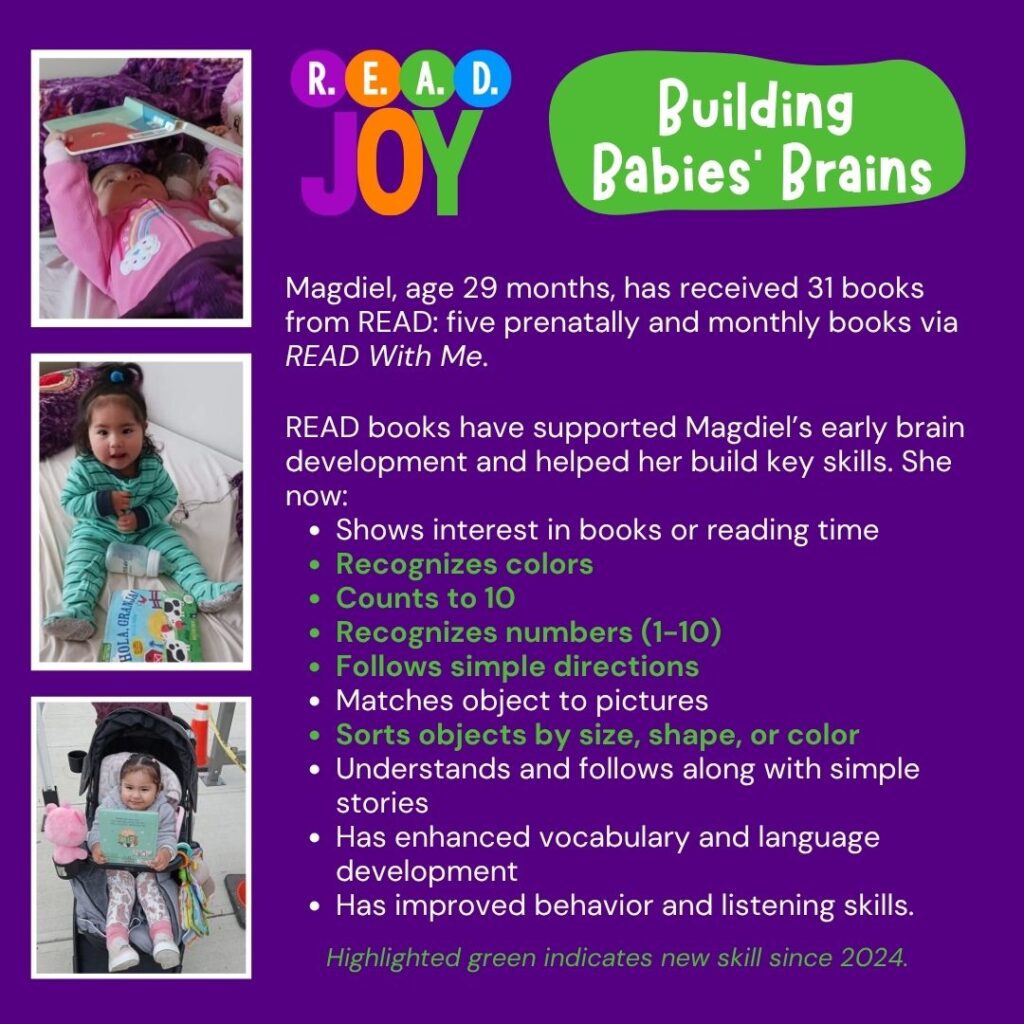
Lucas, age 33 months, has received 38 books from READ: five prenatally and monthly books via READ With Me. READ books have supported Lucas’ early brain development and helped him build key skills. He now:
- Shows interest in books or reading time
- Recognizes colors
- Recognizes basic shapes
- Knows the ABCs and identifies individual letters
- Counts to 10
- Recognizes numbers (1-10)
- Follows simple directions
- Matches object to pictures
- Sorts objects by size, shape, or color
- Speaks in full sentences
- Understands and follows along with simple stories
What ways can the public get involved?
Email clairemorris@readearlyanddaily.org for more information and to sign up to volunteer.
How are charitable dollars spent? Where does my donation go?
Our model is simple. READ gets free, quality, culturally relevant books to vulnerable babies when they need them the most. You can choose to help one baby or many babies.
- $100 helps build and *light up* one baby’s brain
- $500 helps build and *light up* five babies’ brains
- $1000 helps build and *light up* ten babies’ brains
When you support READ, YOU are enhancing the literacy and language experiences of economically vulnerable babies and toddlers at their most vital brain development by providing books for them to keep and for parents to read aloud. These early simple acts of reading together sets a baby on the path to future academic success and self-sufficiency.
Information provided March 2026
Jennifer Bush-Lawson Foundation
 Jennifer Bush-Lawson Foundation
EIN: 47-1374686
Mission Statement
The Jennifer Bush-Lawson Foundation serves economically vulnerable mothers and babies by increasing access to much-needed health care support, conducting research to affect systemic change, and ensuring they have the supplies needed to bring baby home. In honor of Jennifer Lawson, a loving mother of three who tragically lost her life in 2014, we aim to honor her dedication, generosity, and kind heart by fulfilling the vision that she crafted for every mother and baby in need.
Program Summary
We have 3 primary initiatives to accomplish our mission. The first is to ensure families have everything they need to bring baby home safely – from cribs to car seats. The second is to increase access to quality care by funding innovative pilots – such as tele-health – that enable these families to access care that meets their daily needs. The third is to raise awareness of the issues facing this community through thought leader events and social media promotion.
Impact Statement
Throughout our 9-year history we have served more than 3,000 families, provided more than 350 basics materials, hosted 10 awareness campaigns, and funded more than $250,000 to support Including projects focused on infant care, tele-health, & maternal mental health. In addition to these mission related activities, we strive to be nimble in an ever-changing environment to help these families in other important ways. For example, in 2020 we launched a program to put kitchen staff back to work while delivering home cooked meals to new mothers whose family were affected by the economic shutdowns.
What ways can the public get involved?
We have two ways of getting involved with the Jennifer Bush-Lawson Foundation. Volunteer throughout the year by helping us collect gently used baby supplies such as car seats, strollers, and portable cribs. In addition, our signature fundraising event, the 5K and Family Fun day is always in need of volunteers. This event is held the Saturday before Thanksgiving at the Knights of Columbus.
How are charitable dollars spent? Where does my donation go?
The Jennifer Bush-Lawson Foundation is giving economically vulnerable mothers and babies renewed hope by increasing access to much-needed health care support, conducting research to affect systemic change, and ensuring they have the supplies needed to bring baby home. Your support changes lives.
$25 helps provide a breastfeeding starter pack
$50 helps provide a portable crib
$100 helps provide a car seat
Information provided March 2025
Affordable Homes & Communities (AHC)
 Affordable Homes & Communities (AHC)
EIN: 54-1026365
Mission Statement
The residents of Affordable Homes & Communities (AHC) are at the heart of all we do. We build opportunity by creating quality homes with holistic resident services. We drive change through innovation, genuine partnerships, and responsible investment.
AHC envisions a world where all people share the same opportunities regardless of income, race, or other qualities; where housing is integral to a healthy, welcoming, and equitable society; and where affordable homes are available to all.
Program Summary
AHC’s Resident Services program provides a multitude of services for children, families, adults, and senior citizens. The resident-driven program focuses on four key areas of housing stability:
Education & Youth Development: AHC’s educational programs for students K-12 encourage academic and personal growth.
Health & Wellness: AHC supports residents’ holistic well-being by promoting physical, mental, and social health.
Economic Mobility: Through onsite programming, we ensure residents have access to stable housing and key resources to help them thrive.
Community Building & Engagement: Our communities host a variety of activities to bring residents together and build strong connections among neighbors.
Impact Statement
Affordable Homes & Communities provides quality affordable housing enriched by a nationally accredited Resident Service program. In 2025, 6,750 residents were positively impacted by our education and youth development, health and wellness, economic mobility, and community engagement programs. 1,700 residents attended health-related programs, 865 residents were supported with employment services, 165 elementary students participated in the Afterschool Program, and 700 community building events were hosted. This year, AHC proudly recognizes 50 years of building quality homes with holistic resident services.
What ways can the public get involved?
Please visit our website to learn more:
· Volunteer. Join us to tutor students, distribute groceries to a senior citizen, serve a holiday meal, and much more. Activities are available for individuals and groups.
· Donate. Consider making a special tribute gift, ask your employer if they will match donations, or share a meaningful gift through your donor-advised fund.
· Partner with us. We welcome the opportunity to create a meaningful community, corporate, or advocacy partnership to best match your interest in supporting AHC residents.
How are charitable dollars spent? Where does my donation go?
Contributions to Affordable Homes & Communities (AHC) support the year-round Resident Services program. AHC provides vital social services and onsite education, economic, and wellness programs to improve the lives of AHC residents.
Your generosity means more neighbors from low-income households will have a safe and nurturing place to access budgeting workshops, rent relief, vaccine clinics, job readiness workshops, community movie nights, tutoring, summer camp, field trips, college prep for teens, and much more. Thank you!
Information provided March 2026
Wesley Housing
 Wesley Housing
EIN: 51-0155779
Mission Statement
Wesley Housing’s mission is to build up communities with quality affordable housing and resident services.
Program Summary
Beyond building/preserving permanent housing options for persons with low- and moderate-incomes across Virginia and Washington, DC, we strive for our housing to be a foundation to thrive. We do this by offering free support services/education to every to guide residents on their paths to self-sufficiency. As such, our core lines of business are real estate development, asset management, and resident services.
Through our Housing Stability Initiative (HSI), the basis of our award-winning resident services programming, Wesley Housing provides supportive services residents on-site in their communities, including 380 households in Arlington. The Initiative operates on the basis that housing is the foundation families need to thrive, and once stabilized, families can build up other aspects of their lives. As such, in addition to eviction prevention support, the HSI also provides workforce development opportunities, health/wellness offerings, and household assistance.
Impact Statement
For more than 50 years, Wesley Housing has provided permanent, affordable housing to generations of people experiencing financial insecurity.
Today, we own 43 communities home to 5,300 residents, including multi-family apartments and communities for older adults/individuals with disabilities/chronic disease. Five of these communities are located in Arlington County and are home to 816 residents, 87% of which are BIPOC and earn $37,458/year on average.
At the same time, we are still rapidly expanding. Our Real Estate team has 1,000+ affordable units in its development pipeline, including new construction and renovations, such as the Melwood-Wesley Inclusive Community in Arlington.
The impact we make each year is measured by the success of our residents. In 2025, 395 residents accessed linkage and referral services. Through the work of our resident services team, 66 evictions were prevented, 20 residents received new/more gainful employment, 294 residents participated in health/wellness offerings, and 1,453 residents received household assistance (i.e. food/hygiene items). This summer, we served 258 youth through Quest summer camp, and launched Odyssey for older adults, engaging 149 participants. In addition, 606 K-12 students received new backpacks and supplies through Supplies for Success, and 789 residents received holiday assistance through Holiday Help.
What ways can the public get involved?
Wesley Housing welcomes support of our major giving campaigns throughout the year including the Housing Stability Initiative (year-round), QUEST Summer Youth Enrichment Program (April/May), Back-to-School (July/Aug), and Holiday Help (Nov-Dec).
In addition, volunteers serve in many capacities including youth and adult education assistants and tutors; translators; holiday helpers (gift wrappers, sorters) and delivery drivers; food pantry assistants; youth summer camp chaperones; and more.
How are charitable dollars spent? Where does my donation go?
Donations help strengthen our award-winning Housing Stability Initiative (HSI) by allowing us to adequately scale our resident services to our growing portfolio. Following a recent merger with Virginia United Methodist Development Corporation, Wesley is poised to serve even more residents across its new footprint in central and southern Virginia. Funding will help ensure each of these community members have access to the support they need to thrive.
Information provided March 2026
Capital Caring Health
 Capital Caring Health
EIN: 54-1920770
Mission Statement
Capital Caring Health’s mission is to provide compassionate end-of-life support for individuals with life-limiting illnesses, offering high-quality care to patients of all ages and their families, regardless of one’s ability to pay.
Program Summary
At Capital Caring Health (CCH) we provide comprehensive hospice care, including a dedicated bereavement program to support families.
Through our Capital Caring Kids (CCK) program, we offer specialized pediatric care that addresses the social, emotional, psychological, and spiritual needs of children facing serious illness. CCH and CCK provide compassionate care for the entire family, understanding the impact of long-term illness on loved ones. We provide support through the challenges of illness and help families navigate each step along the way.
Impact Statement
In 2024, Capital Caring Health provided care to 6,545 patients and offered bereavement support to 4,752 individuals. Capital Caring Health is projected to provide $1,463,000 in charity care to cover services and supplies.
What ways can the public get involved?
Capital Caring Health provides a variety of volunteer opportunities. For more details, please visit this link: https://www.capitalcaring.org/get-involved/become-a-volunteer/
How are charitable dollars spent? Where does my donation go?
At Capital Caring Health
- A gift of $30 will provide one day of three Nutrional meals delivered to a patient’s home.
- A gift of $110 can provide in-home telehealth equipment to keep our patients connected to expert medical care.
At Capital Caring Kids
- A gift of $25 can provide therapeutic play supplies for a child.
- A gift of $100 can provide a pediatric patient without insurance specialty medical equipment.
Information provided March 2025
The Sycamore School
 The Sycamore School
EIN: 47-4551914
Mission Statement
To provide a dynamic, nurturing and personalized education that inspires a passion for learning, self-discovery and connection to the community.
Program Summary
TSS follows a mastery-based learning model that integrates academic development, social and emotional growth, and civic engagement. We create a meaningful learning process, whereby teachers personalize instruction according to students’ interests, needs, and aptitudes. Teaching focuses on cultivating transferable skills in students that apply to various jobs or tasks across settings, such as effective communication, collaboration, critical thinking and creativity. We don’t give grades or tests; our core learning tools include feedback and reflection. We’re intentionally small, maintaining a 1:6 teacher to student ratio for middle school and 1:7 for high school. We can accommodate students who have a specific learning disability, anxiety, ADHD, high functioning autism, and/or social skills deficits. However, we are not a school specifically for students with learning struggles. We want to attract a cross section of students who reflect the diversity that is present in our larger population. Our target student is curious, wants to learn, and is looking for a more progressive learning environment.
Impact Statement
TSS provides personalized, inquiry-based experiential learning, helping students make connections across content areas and to the real world. Many of our students learn differently and may require a more flexible learning environment that explicitly teaches executive functioning skills and social emotional skills alongside academic skills. Our accommodations are specific to the student and we provide both remediation and acceleration depending on the student and their unique needs. Many of our students are twice exceptional (2E), meaning that they are gifted in one area but struggle in another area. Our students cultivate the skills necessary to be independent life-long learners, such as effective communication, critical thinking, problem-solving, time management, cognitive flexibility, perspective taking, and teamwork. In middle school, our focus is on skill development. In high school, we want our students to apply the skills they’ve learned to new situations, effectively advocate for themselves, and take ownership of their learning. Our students graduate TSS with a mastery-transcript that is similar to a digital portfolio, showcasing their areas of study, strengths, and interests. It includes the skills they have mastered and exemplar pieces of work, such as a capstone project.
What ways can the public get involved?
We partner with other nonprofits, local businesses, and professionals in our community to provide community service, a speaker series, internships, career day, and volunteer opportunities. Fridays are TSS’s community-based learning days, where our students go into the community on field trips and community service outings. Sometimes, the community comes to us. We regularly host guest speakers and have school demonstrations and activities. Individuals can volunteer to be a guest speaker, capstone project mentor, and/or a community partner.
How are charitable dollars spent? Where does my donation go?
TSS is a small independent nonprofit school that does not receive any federal or state funding. As such, our revenue comes from tuition and fundraising. We raise funds to offer need-based financial aid and reach underserved students. We are always striving to increase the diversity in our community. We try to keep our tuition affordable to attract a wide range learners. Many of our students are neurodivergent and require small classes and individualized instruction to access the curriculum. Other students have felt unsafe in larger school settings and seek an inclusive safe space to be their authentic selves. We are proud to have a large LGBTQIA+ community at our school, reflected in our students and staff.
Information provided April 2025