
Population: Disabled
 Guardian Hands
 Guardian Hands
EIN: 92-1655080
Mission Statement
Guardian Hands empowers adults with intellectual and developmental disabilities to achieve greater independence, community inclusion, and workforce readiness through person-centered support, community engagement, and real-world skill development. We are committed to helping individuals build confidence, develop meaningful relationships, and pursue opportunities that enhance their quality of life throughout Northern Virginia, including Arlington County, Fairfax County, and the City of Alexandria.
Program Summary
Community Engagement Services
Guardian Hands provides structured community-based activities that help adults with intellectual and developmental disabilities build social skills, increase independence, and actively participate in community life. Participants engage in recreational, educational, and volunteer activities while developing communication, decision-making, and self-advocacy skills.
Group Day Support
Our non-center-based Group Day Support program offers individualized and small-group instruction designed to promote independent living skills, community integration, and personal growth. Participants receive support in developing daily living skills, social interactions, safety awareness, and community navigation.
Impact Statement
Guardian Hands Inc. helps adults with intellectual and developmental disabilities overcome barriers to independence, employment, and community participation. Through community-based services and workforce readiness training, participants develop practical life skills, strengthen social connections, increase confidence, and build the tools needed to navigate their communities more independently. Our programs promote inclusion, self-determination, and meaningful opportunities for individuals to reach their personal goals while enhancing their overall quality of life.
What ways can the public get involved?
- Volunteer during community outings and special events.
- Assist with workforce readiness workshops and mock interviews.
- Donate professional clothing, work shoes, backpacks, and employment-related supplies.
- Sponsor transportation passes and community participation activities.
- Make financial contributions to support workforce readiness and community integration programs.
- Introduce local businesses interested in providing volunteer, internship, or employment opportunities for adults with disabilities.
- Partner with Guardian Hands to host inclusive community events and educational opportunities.
How are charitable dollars spent? Where does my donation go?
- $25 provides a participant with transportation assistance for community-based workforce readiness activities.
- $50 purchases job-readiness workbooks, learning materials, and skill-building resources.
- $100 helps provide professional clothing and interview preparation supplies for an adult preparing for employment opportunities.
- $250 supports a month of transportation and community integration activities for one participant.
- $500 funds workforce readiness materials and mobility training resources for multiple participants.
- $1,000 helps expand the Path to Independence program by providing transportation vouchers, vocational materials, and employment preparation supports for adults with intellectual and developmental disabilities.
Donations directly support community engagement, workforce readiness training, transportation access, and independent living skill development, helping adults with intellectual and developmental disabilities achieve greater independence and inclusion in Arlington, Fairfax, and Alexandria.
Information provided June 2026
Jews United for Justice
 Jews United for Justice
EIN: 52-2346578
Mission Statement
Jews United for Justice advances economic, racial, and social justice in Washington, DC, Maryland, and Virginia by educating and mobilizing our local Jewish communities to action.
We move our region closer to equity and justice by advancing issue-based campaigns that make real, immediate, and concrete improvements in people’s lives and build the power of working-class and poor communities of color. Through these campaigns we develop leaders, build our Jewish grassroots community, shift the consciousness of our community, and build the collective power needed to undo systemic racism and inequality.
Program Summary
For more than a quarter century, Jews United for Justice (JUFJ) has worked in coalition to win policy changes – like increasing the minimum wage, expanding access to affordable housing, and providing paid family leave to everyone – that make concrete improvements in the lives of millions of people. JUFJ simultaneously builds a vibrant Jewish community and Jewish home for local activists, who gather together for Jewish holiday celebrations and to take powerful action on local issues together. Through this work, JUFJ builds partnerships with non-Jewish organizations and communities across the region that increases understanding of the Jewish community and establishes the foundation for shared efforts to dismantle antisemitism, racism, and xenophobia.
JUFJ launched our work in Arlington and more broadly in Northern Virginia in 2025. We are currently:
- Building a vibrant community of leaders and volunteers committed to advancing justice
- Helping to win Constitutional Amendments to advance voting rights, marriage equality, and reproductive justice
- Mobilizing the Jewish community to support and protect immigrants in the region.
Impact Statement
JUFJ’s work targets two distinct communities. Through our policy advocacy campaigns, JUFJ’s work benefits millions of people in our region who are living in poverty or who are otherwise vulnerable. We work collaboratively with faith, community, and advocacy groups of people who are most directly and negatively impacted by the problems we seek to address, and we follow their leadership. Due to the advocacy of JUFJ and our partners, we have worked successfully for Paid Family Leave in Maryland and DC, Paid Sick Days in Maryland and DC, progressive tax laws, and many more policies that have a positive impact on people in our region.
Our work also directly impacts the lives of our base of mostly- Jewish volunteers, who plan and lead our programming, public education, and issue campaigns. This uniquely intergenerational constituency builds strong relationships, Jewish identity, and community, and often describes JUFJ as their Jewish home. They build leadership and advocacy skills and are part of a community working for justice.
What ways can the public get involved?
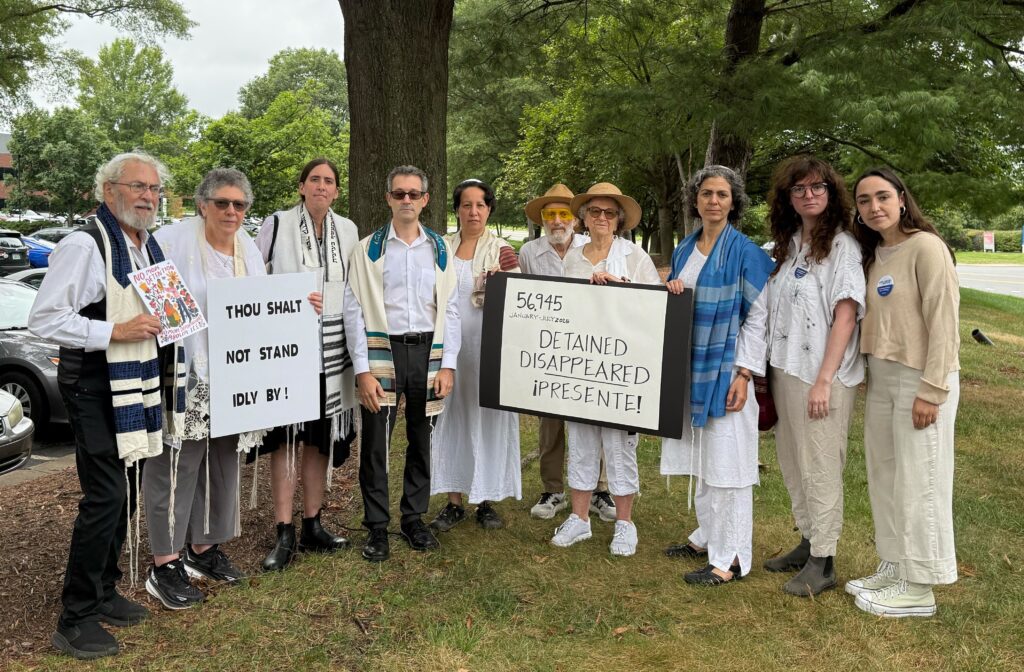
JUFJ is building a powerful group of volunteers that will fight for a more just state, and we are recruiting Virginians to volunteer with us. We invite you to join us at rallies, meetings with elected officials, and at our cultural and educational events. Our current advocacy is focused on supporting three state constitutional amendments to enshrine Voting Rights, Marriage Equality, and Reproductive Justice in the Constitution, and to advance Immigrant justice. We hope you will join us!
How are charitable dollars spent? Where does my donation go?
JUFJ is a careful steward of the money we raise, ensuring every dollar is spent wisely to help us advance our goals of a more just region.
More than 90% of our budget goes to our core staff costs. That staff provides the foundation to enable coordinated collective action with hundreds of multi-racial, multi-faith partners across the region, and to support our volunteer leaders to advance the work. We are actively seeking support to sustain and expand our staff team in Northern Virginia.
Information Provided February 2026
Community Residences Inc (CRi)
 Community Residences Inc (CRi)
EIN: 54-1004092
Mission Statement
CRi envisions a world where all people have Choice, Respect, Independence, and the support needed to live a fulfilling life. We deliver personalized resources to youth and adults with mental health support needs and developmental disabilities, and for 50 years have promoted equity by aiding people with these diagnoses to live in diverse communities. Started in Arlington as part of the de-institutionalization movement, CRi provides services via a person-centered approach that emphasizes individual needs and preferences. CRi services help Virginians to increase their stability, autonomy, and well-being – via community homes, supervised residential services, and community-based case management services.
Program Summary
CRi Programs serve people with intellectual and developmental disabilities, mental health support needs, and youth as they age out of foster care:
- Developmental Disabilities programs include neighborhood-based shared living community homes, Supported Living services that promote skills building for community integration as well as daily care for individuals with intellectual and developmental disability (I/DD) diagnoses, and intermediate care facilities (I/DD/ICF) that provide 24-hour clinical support to prevent hospitalization or admission to a nursing facility. As part of these programs CRi provides Behavioral Therapeutic Consultation, to aid caregivers to implement each client’s Individual Support Plan, which is developed with families and clinical staff to help reach individual goals.
- In Virginia, CRi’s Mental Health programs focus on evidence-based skills building services for recovery, delivered through supervised community living in residential apartment settings.
- Tenant Support Services reach individuals with either disabilities or a mental health diagnosis, or a dual diagnosis. Case managers aid clients to set goals for independent living, develop measurable plans, and strengthen the skills needed to be a responsible tenant.
- The Living Independently for Tomorrow (LIFT) program serves youth age 17-21 as they transition out of foster care, via provision of apartment-based case management and support services for housing, employment, and therapeutic needs.
Impact Statement
CRi measures its impact beyond the number of people served each year – which in FY24 was 700 people in Virginia and Maryland. Clinical staff work with clients and families to develop an Individual Support Plan or Individual Recovery Plan for every person in each program, which helps measure progress toward goals such as community integration and outcomes including improved communication, pro-social behaviors, money management skills, and use of community resources. We assess the quality of CRi’s services by tracking individual advancement, and by gathering feedback via an annual client satisfaction survey. Over 460 individuals responded to the 2024 survey, with results reflecting the strong relationships developed in CRi’s programs. Over 90% of individuals agreed that they feel heard, understood, and respected. This impact can be seen in the success stories of people we serve, in an increased ability to participate in community events and connect with others, in the improvement in symptoms of a mental illness, the capacity to maintain one’s own clean apartment, and the capability to sustain employment or education.
What ways can the public get involved?
Financial donations of any size are always welcome, and a small monetary amount can help our individuals participate in community events and activities such as local music concerts and movies, by contributing to transportation funds. People who are interested in collaborating with CRi can also volunteer and/or advocate with us, and/or donate in-kind items. Our Volunteer Program Manager organizes activities with local businesses and civic groups to help us maintain and beautify our community houses, plus events with Volunteer Arlington and Volunteer Fairfax, such as the annual Martin Luther King Jr. Day of Service in January. We can work with teachers and schools to help students fulfill service hours. Civic groups can also visit a program in their community and bring arts and craft supplies or board games, and can assemble kits to support our individual residents, e.g., with hygiene kits or “busy boxes.” CRi also has an Advocates Group to aid our leadership in publicly supporting our work with individuals with disabilities and mental health diagnoses.
How are charitable dollars spent? Where does my donation go?
Financial contributions support CRi’s general operating costs, such as providing transportation for youth and adults to community events and appointments with healthcare providers. For adults with developmental disabilities and/or mental health support needs, a donation of $50 will enable our staff to transport and accompany an individual on an outing such as a concert by the Arlington Philharmonic Orchestra. $100 would help provide gardening supplies to maintain the 11 community homes we manage in Arlington and Falls Church. Larger donations, such as from a Donor Advised Fund, could help us with staff appreciation and professional development for our dedicated Direct Support Professionals, who provide the services to the individuals we serve.
Information provided March 2026
Brain Injury Services
 Brain Injury Services
EIN: 54-1346045
Mission Statement
Empowering those impacted by brain injury
Program Summary
Brain Injury Services (BIS) helps children, adults, and families whose lives have been changed by brain injury build the skills and confidence they need to live their best life.
We work with individuals across Northern Virginia, Fredericksburg, and surrounding communities who have sustained acquired or traumatic brain injuries. Our clients range from children and young adults to older adults and veterans.
Core Programs & Services
- Case Management & Service Coordination
- Individualized assessment and goal planning.
- Connection to medical, vocational, educational, and community resources.
- Ongoing support to navigate systems and remove barriers to independence.
- ADAPT Clubhouse
- Day program designed to foster social connections, skill-building, and community participation.
- Peer-to-peer support in a welcoming, recovery-focused environment.
- Vocational Services
- Career exploration, job readiness training, and supported employment.
- Partnerships with employers and organizations to create accessible work opportunities.
- Children & Youth Services
- Support for students with brain injuries to succeed in school and transition into adulthood.
- Collaboration with families, educators, and healthcare providers.
- Mental Health Support
- Counseling, peer mentoring, and therapeutic groups to address emotional and psychological needs related to brain injury.
- Assistive Technology & Independent Living Skills
- Training and access to adaptive tools that improve daily functioning.
- Skill development for independent living, community navigation, and self-advocacy.
Our Approach
- Person-Centered: Services are built around each client’s unique needs, goals, and pace of recovery.
- Community-Based: We meet clients where they are—at home, in the community, or virtually.
- Collaborative: We work closely with care teams (families, healthcare providers, schools, and employers) to create coordinated support networks.
- Empowerment-Focused: We help clients by fostering their independence, confidence, and participation in meaningful activities.
Impact Statement
Brain Injury Services empowers individuals with brain injuries to reclaim their independence, re-engage in their communities, and achieve personal and professional goals. Through personalized support, skill-building, and access to resources, our clients gain increased confidence, improved daily functioning, stronger social connections, and greater participation in the workforce—transforming lives and reducing isolation for one of the most underserved populations in our region.
What ways can the public get involved?
1. Provide Financial Support
- Make a one-time or recurring gift to sustain core programs and expand services.
- Sponsor specific initiatives like vocational training, assistive technology, or the ADAPT Clubhouse.
2. Support Events & Campaigns
- Attend or sponsor BIS events such as our Annual Golf Tournament or BIS Has Talent or awareness campaigns.
- Host a peer-to-peer fundraiser to rally friends, family, and colleagues in support of BIS.
3. Give In-Kind Donations
- Contribute items like technology, art supplies, transportation vouchers, or adaptive equipment that directly benefit clients.
4. Volunteer
- Offer your skills in mentoring, career coaching, advocacy, or event support.
- Become a PAL in our Friendship Program
5. Become an Advocate
- Help raise awareness about brain injury by sharing BIS’s mission and stories and social media posts.
- Engage with local and state legislators to promote policies that improve access to brain injury services.
6. Leave a Legacy
- Include BIS in your estate plans or create a named fund to ensure long-term support for survivors of brain injury.
How are charitable dollars spent? Where does my donation go?
When you give to Brain Injury Services (BIS), you make it possible for children, adults, and families living with the effects of brain injury to rebuild their lives. Every donor dollar directly supports programs that foster independence, confidence, and community connection.
Your contribution helps fund:
- One-on-One Case Management: Guiding clients through recovery, connecting them to resources, and helping them achieve personal goals.
- Vocational Services: Providing job readiness training, supported employment, and partnerships with employers to create meaningful work opportunities.
- ADAPT Clubhouse & Day Programs: Offering a safe, supportive space for skill-building, social interaction, and peer support.
- Children & Youth Services: Ensuring students with brain injuries have the tools and advocacy they need to succeed in school and beyond.
- Mental Health & Wellness Support: Counseling, peer mentoring, and therapeutic groups to address emotional needs.
- Assistive Technology: Access to tools that make daily living and employment possible.
By giving to BIS, you help reduce isolation, open doors to opportunity, and empower survivors of brain injury to thrive. Every dollar is an investment in recovery, dignity, and a brighter future.
Information provided August 2025
Arc of Northern Virginia
 Arc of Northern Virginia
EIN: 54-0675506
Mission Statement
The Arc of Northern Virginia promotes and protects the human rights of people with intellectual and developmental disabilities and actively supports their full inclusion and participation in the community throughout their lifetimes.
Program Summary
1. Transition POINTS Program
Transition POINTS guides individuals with intellectual and developmental disabilities (IDD) and their families in Arlington through critical life transitions, from birth to adulthood. The program offers free tools, workshops, and customized support to help navigate decisions related to early intervention, school services, employment, independent living, and long-term planning. By empowering families with resources and guidance at each life stage, Transition POINTS helps promote independence, inclusion, and long-term well-being.
2. Special Needs Trust Program
The Arc of Northern Virginia administers Special Needs Trusts to help individuals with disabilities secure their financial future without jeopardizing eligibility for public benefits. These trusts are professionally managed and available to people of all ages and disability levels in Arlington. The program includes personalized trust management, financial oversight, and ongoing support for families to ensure that individuals with disabilities in Arlington can maintain quality of life while preserving public supports.
3. Advocacy & Public Policy
The Arc of Northern Virginia leads local and state advocacy efforts to advance policies that promote equity, access, and opportunity for individuals with IDD. Through community engagement, education, and legislative action, the organization works to influence public policy on issues like inclusive education, affordable housing, transportation, and employment.
4. Tech for Independent Living
This Arc of Northern Virginia program provides access to ongoing, customized support for employment and daily life for individuals with IDD in Arlington. At its core is the Arc2Independence app that focuses on four categories of skill building: Employment Skills: a “virtual job coach” supporting work tasks and soft skills; Travel Skills: a “virtual travel trainer” to support safe and independent public transit use; Safety Skills: “a virtual safety coach” to navigate real-world situations safely at home and in the community; and Daily Living Skills:” a virtual skills trainer” to support independence at home and in the community
Impact Statement
The Arc of Northern Virginia empowers individuals with intellectual and developmental disabilities (IDD) to live full, independent, and inclusive lives. Through a wide range of programs and services, the organization supports people with disabilities across all life stages, from early childhood to adulthood and aging. We provide families critical guidance through complex systems, including school services, employment, housing, and long-term care planning. The Arc’s Special Needs Trust Program protects financial security without affecting public benefits, ensuring long-term stability and peace of mind. Innovative technology tools and personalized coaching promote daily living skills and greater independence, while advocacy efforts at the local and state levels drive policy changes that expand access to education, housing, and employment. Each year, thousands of individuals and families benefit from The Arc’s resources, workshops, and direct services, gaining the tools and confidence to lead self-determined lives. The organization also collaborates with schools, employers, and community partners to foster greater awareness, accessibility, and inclusion. As a result, more people with disabilities in Northern Virginia are achieving personal goals, connecting with their communities, and living “A Life Like Yours.”
What ways can the public get involved?
Community members play a vital role in supporting The Arc of Northern Virginia’s mission. There are many ways to get involved:
- Volunteer: Help with special events, office support, or become a trained advocate to assist individuals with disabilities. See our volunteer opportunities: https://thearcofnova.org/volunteer-catalog/
- Advocate: Join advocacy campaigns to influence local and state policies that affect people with intellectual and developmental disabilities. Sign up for action alerts and attend legislative events.
- Donate: Financial contributions support critical programs, services, and resources that directly impact individuals and families in need. Make a donation on our volunteer page: https://arcofnva.app.neoncrm.com/np/clients/arcofnva/donation.jsp?campaign=127
- Attend Events: Participate in our community events, educational workshops, and fundraising activities to connect with others and raise awareness.
- Partner: Businesses, schools, and organizations can collaborate through sponsorships, internships, and inclusive employment opportunities.
- Spread the Word: Follow The Arc of Northern Virginia on social media, share stories, and help raise awareness about disability rights and inclusion.
How are charitable dollars spent? Where does my donation go?
Donations to The Arc of Northern Virginia directly support programs and services that empower individuals with intellectual and developmental disabilities (IDD) and their families. Charitable dollars fund critical initiatives such as personalized support through the Transition POINTS program, employment and life-skills support through our Tech for Independent Living Program, access to life-planning tools and Special Needs Trusts, and the development of innovative technology that promotes independence.
Gifts also help provide free educational workshops, advocacy training, and one-on-one guidance to thousands of families each year. Additionally, donations sustain public policy efforts that lead to lasting systems change at the local and state levels.
Approximately 85% of every dollar goes directly to programs and services, ensuring that your contribution has a meaningful and immediate impact. The remaining funds support essential administrative and fundraising operations that keep our organization running efficiently and transparently.
Your support helps individuals with disabilities gain greater independence, secure their futures, and thrive as fully included members of our community. Every gift makes a lasting difference.
Information provided March 2026
Free2Talk
 Free2Talk
EIN: 88-3583665
Mission Statement
Free2Talk is a non-profit, 501(c)3 organization dedicated to supporting the mental health of kids and teens in Virginia (ages 6-19). We believe that accessible and affordable therapy, including speech therapy, is vital for all young people struggling across the Commonwealth. Regardless of family income or insurance coverage, Virginia kids and teens should be able to access mental health and speech therapy treatment.
Program Summary
Free2Talk connects families, struggling to afford treatment, with a network of mental health and speech therapy providers and specialists, allowing them to access reduced cost treatment for their kids and teens. For qualified patients, our organization will pay up to 80% of treatment costs for up to 16 sessions.
We work primarily with providers and patients in Arlington, but also across the Commonwealth. Free2Talk was founded in the summer of 2022 by William Mount, a then-10th grade student at Washington-Liberty HS in Arlington, VA. His idea originated from his own personal struggles with mental health and stuttering.
Impact Statement
We have covered 80% of the costs of nearly 500 therapy sessions by collaborating with over a dozen therapy providers and practices across Virginia — with our most served areas being Arlington, Alexandria, Fairfax County, and the greater Charlottesville area.
Founder William Mount has attended, and spoken to/at various of local expos, elementary schools, foundations and fundraising events to promote the de-stigmatization of speaking about mental health and speech struggles amongst younger people. In addition, Free2Talk has tabled at local events sponsored by organizations like the Center for Youth and Family Advocacy (CYFA).
Free2Talk is also in collaboration with the University of Virginia’s Sheila C. Johnson Center for Clinical Services, and has worked with them for over a year to provide Free2Talk’s services to areas beyond Northern Virginia.
How are charitable dollars spent? Where does my donation go?
Donations to Free2Talk always go directly subsidizing the costs of the mental health/speech therapy sessions of our patients.
Donations ranging from $100-$250 cover the cost of a typical therapy session for one of our patients. Larger donations are greatly appreciated; 16 sessions for each approved patient leads to an individual cost of ~$2,000. Large donations help us to scale in size, and excess funds allow Free2Talk to expand our network of providers to further address the immense need for therapy in Arlington, and beyond.
Information provided March 2026
Arm & Arm Inc.
 Arm & Arm Inc.
EIN: 47-4617475
Mission Statement
The Arm & Arm Mission is to change the paradigm of how the transition process is addressed. Using our empathetic-based approach, we empower individuals during critical transition periods with tools that enable them to make rational evaluations of themselves and their situations.
Program Summary
Arm & Arm is redefining mental health and recovery by utilizing cutting-edge Cognitive and Somatic Recovery Techniques—proven methods that help individuals process trauma, regulate emotions, and develop self-sustaining coping strategies. Unlike traditional clinical programs, our model is peer-driven, allowing individuals with shared life experiences to mentor and guide others through their recovery.
Impact Statement
Arm & Arm is redefining mental health and recovery support by utilizing cutting-edge Cognitive and Somatic Recovery Techniques—proven methods that help individuals process trauma, regulate emotions, and develop self-sustaining coping strategies. Unlike traditional clinical programs, our model is peer-driven, allowing individuals with shared life experiences to mentor and guide others through their recovery. By providing peer-to-peer mentoring (a system of accountability) and educating the community on the signs and possible interventions to substance use and de-escalation strategies prior to police involvement, Arm & Arm is normalizing prevention as a lifestyle for our targeted population and their families.
What ways can the public get involved?
Arm & Arm is always looking for empathetic volunteers willing to help those in the community living with stigma. Anyone who is willing to donate their time and/or money to assist our efforts in building whole & healthy communities are always welcome.
How are charitable dollars spent? Where does my donation go?
To provide support for training, community outreach services and support.

Information provided March 2025
Ayuda
 Ayuda
AyudaEIN: 52-0971440
Mission Statement
Ayuda advocates for low-income immigrants through direct legal, social and language services, training and outreach in Washington, D.C., Maryland, and Virginia.
Program Summary
Ayuda provides legal, social, and language services for low-income immigrants including individuals and families affected by immigration challenges, domestic violence, sexual assault, human trafficking, and family separation, ensuring access to justice and support for vulnerable communities.
Impact Statement
For over 50 years, Ayuda’s expert team has helped over 150,000 immigrants navigate complex legal systems and access vital services. With offices in DC, Maryland, and Virginia, we offer both in-person and virtual services to reduce barriers. We also provide emergency financial, food, and material assistance to those in crisis, ensuring immigrants have the support they need to build safe, stable lives.
In 2024, Ayuda provided 3,109 low-income immigrants from 84 countries with immigration legal services, domestic violence, and family law services, comprehensive case management, and/or therapy. 165 language experts contributed to our interpreter bank, accessible to 118 nonprofits, allowing them to break down language barriers as they support clients. Over $228,000 in financial assistance, 21,400 pounds of diapers, and 2,800 pounds of food were distributed to help new immigrant families thrive.
What ways can the public get involved?
There are different ways to get involved with Ayuda. Visit https://ayuda.com/get-involved/ to learn more and support our mission by:
- Joining our mailing list
- Donating to Ayuda
- Fundraising for Ayuda
- Becoming a pro bono partner
- Interning with us
- Attending an Ayuda event
- Joining our growing staff
How are charitable dollars spent? Where does my donation go?
Donations to Ayuda help us provide vital immigration legal services, offer compassionate case management, extend a helping hand through mental health services, and bridge the language gap for low-income immigrant families in the DMV area.
- $10 will provide public transportation for a human trafficking survivor to travel to her new job.
- $50 will provide group therapy support for survivors of domestic violence.
- $100 will provide legal consultation for a low-income individual fleeing violence in their country of origin.
- $200 will cover the legal fees for the immigration case of an immigrant child to remain in the United States safely.
Information provided March 2026
Legal Services of Northern Virginia
 Legal Services of Northern Virginia
EIN: 54-1137931
Mission Statement
To provide access to justice for disadvantaged individuals and communities.
Program Summary
LSNV provides free legal help to Arlingtonians who cannot afford a lawyer by providing services in a variety of substantive civil legal areas, including: family law/domestic violence, housing law/eviction prevention, consumer protection, elder law, public benefits claims, access to health care, child advocacy, and AIDS/HIV issues. Staff and volunteers provide legal advice, brief service, and representation in administrative hearings and in court, as well as community legal education, and advocacy before local and state governmental entities, all without charge to our clients.
What ways can the public get involved?
Volunteer. Every year we work with hundreds of volunteer lawyers and paralegal who help us extend our reach and serve more clients.
Financial support.
How are charitable dollars spent? Where does my donation go?
Donations go to direct services; helping a survivor of domestic violence obtain a protective order and escape the cycle of abuse; helping a low-income family avoid eviction and stay in their home; helping a low-income veteran obtain the benefits that he is entitled to after decades of services; and many other types of cases which impact basic needs.
Information provided March 2026