
population-scope: Arlington
 Arlington Soccer Association
 Arlington Soccer Association
EIN: 23-7284150
Mission Statement
Provide quality soccer programs and experiences for youth of all abilities, backgrounds and financial means to encourage personal growth, promote a love for the game, and advance soccer in Arlington and surrounding communities.
Program Summary
Arlington Soccer Association offers recreational, developmental and travel soccer, as well as a number of camps, clinics and other programs throughout the year. Over 9,000 children take advantage of Arlington Soccer programs each year!
How are charitable dollars spent? Where does my donation go?
For the Arlington Soccer Association, a 501(c)(3) nonprofit organization, charitable donations are vital to supporting its mission and operations. Generally donations go towards financial aid, unless they are specifically earmarked for other causes. Here is how financial aid funds are typically utilized:
Financial Aid for Players: Donations designated for financial aid are used to subsidize the costs for players who may not otherwise be able to afford to participate in the soccer programs. This can include covering part or all of the fees associated with:
- Registration Fees: These are often the primary costs associated with joining the soccer programs. Financial aid can help cover these expenses to ensure every child has the opportunity to play, regardless of their financial background.
- Uniforms and Equipment: Soccer requires specific gear, such as jerseys, shorts, socks, cleats, and shin guards. Financial aid can help families obtain these necessary items.
- Travel Costs: For travel teams, expenses can include transportation, lodging, and meals for away games and tournaments. Financial aid can help ensure that all team members can participate in these important events.
Information provided March 2026
Latinas Leading Tomorrow
 Latinas Leading Tomorrow
EIN: 27-5119847
Mission Statement
Our mission is to connect and expose Latinas to opportunities that enrich their future through education, mentoring and leadership development
Program Summary
We are dedicated to empowering Latina middle and high school students through our free programming initiatives. These programs, specifically designed for Latinas leading tomorrow, encompass a range of opportunities. From our CORE (Creating Opportunities to Reach Excellence) program, which lays the groundwork for future success, to our ELITE Leadership Academy, where leadership skills are honed within a supportive team environment, we strive to provide avenues for personal and academic growth. Additionally, our LLT STEMpower Camps serves as a platform for Latinas to excel in these critical fields, equipping them with the skills and confidence to become leaders in STEM and beyond. Through these initiatives, we aim to inspire and empower the next generation of Latina leaders to reach their full potential and make a meaningful impact in their communities and beyond.
Impact Statement
Our organization’s efforts have yielded significant outcomes for the population we serve. Latinas Leading Tomorrow has positively impacted a diverse demographic, with 65% coming from low-income backgrounds, 60% being first-generation students, and 50% raised in single-parent households. Remarkably, 90% of our participants have successfully transitioned to college, showcasing the profound effect of our work.
What ways can the public get involved?
Ways the Public Can Get Involved with Latinas Leading Tomorrow
There are many meaningful ways individuals, organizations, and businesses can support the mission of Latinas Leading Tomorrow and help empower the next generation of young women leaders.
Volunteer with Our Programs and Events
Community members can volunteer their time by supporting student workshops, mentoring sessions, STEM activities, or helping at community events such as our Noche de Impacto celebrations, STEM Boot Camps, and college exposure trips.
Become a Speaker or Mentor
Professionals are invited to share their career journeys and expertise with our students through guest speaking opportunities, career panels, and mentorship sessions that inspire young women to explore new possibilities.
Partner with Us
Organizations, universities, and businesses can partner with LLT to create internships, host educational experiences, sponsor programs, or collaborate on initiatives that expand opportunities for our students.
Make a Donation or Provide In-Kind Support
Financial contributions and in-kind donations such as school supplies, technology, transportation support, or event sponsorships help ensure that our programs remain accessible to the students and families we serve.
Host or Support a Fundraiser
Community members can help raise awareness and resources by organizing fundraising events, sponsoring program activities, or participating in events like our Reach for the Stars 5K or Noche de Impacto celebrations.
Together, we can create more opportunities for young women to grow as confident leaders, pursue higher education, and shape the future of our communities.
How are charitable dollars spent? Where does my donation go?
Latinas Leading Tomorrow allocates $0.89 to $1 of each dollar towards programming, directly supporting mission-related activities and services. Here’s a detailed breakdown:
Programming Expenses: This part of the budget covers essential activities and services that fulfill the organization’s mission. For instance, it includes expenses for program materials like T-shirts and educational materials, as well as provisions for meals/snacks and transportation for field trips. Additionally, it covers costs for a program coordinator to oversee operations.
Administrative Costs: Administrative expenses pertain to the overall running of the organization and include expenditures like rent for storage space and dues & subscription expenses.
Fundraising Expenses: Funds dedicated to fundraising cover various costs associated with generating additional financial support for the organization’s mission. This encompasses expenses related to events like 5K Run/Walk, marketing and advertising efforts, donor outreach, and engaging a race timer.
Information provided March 2026
Friends of Clarendon House
 Friends of Clarendon House
EIN: 54-1644438
Mission Statement
In existence since 1992, the Friends is a group of individuals who support Arlington’s mental health programs, especially Clarendon House, and individuals served by Arlington’s Behavioral Healthcare Division.
How are charitable dollars spent? Where does my donation go?
Housing assistance, medical and dental expenses, food pantry, social activities
Information provided March 2026
CARE, Inc.
 CARE, Inc.
EIN: 54-1807476
Mission Statement
CARE, Inc. mobilizes partnerships and community leadership to connect people with resources, opportunities, and support systems that strengthen families, enrich lives, and build a more inclusive and economically vibrant community.
We foster trust, cultivate collaboration, and deliver impactful programs that advance education, economic empowerment, and community well-being.
Program Summary
CARE, Inc. (Community Association of Resources, Education, Enrichment & Economics) is a community-rooted nonprofit dedicated to strengthening families and advancing underserved communities.
We serve as a trusted connector—bringing together residents, service providers, local businesses, and strategic partners to build a more equitable, resilient, and thriving community. Through collaborative initiatives, including the Green Valley Farmers Market, we expand access to fresh food, economic opportunity, youth development, and supportive services that uplift generations.
Our work is grounded in relationships, driven by community voice, and focused on creating sustainable systems that support health, stability, and long-term prosperity.
CORE PROGRAM AREAS
🥕 1. Green Valley Farmers Market (Food Access + Economic Development)
- Weekly seasonal farmers market in a historically underserved community
- Increases access to fresh, culturally relevant foods
- Supports local farmers, small businesses, and entrepreneurs
- SNAP/EBT access and healthy food incentives (planned/expanding)
🚲 2. Youth Development & Workforce Pipeline (Ages 10–18)
- Gardening Apprenticeship Program (GAP)
- Financial literacy, entrepreneurship, and job readiness training
- Youth-run market participation (vendors, operations, leadership roles)
- Summer internships and community service engagement
👵🏽 3. Seniors & Aging in Place
- Food access support through market and delivery options (developing)
- Resource navigation for housing, health, and social services
- Community connection to reduce isolation
- Advocacy for affordable housing and aging-in-place solutions
COMMUNITY NEED
- Limited access to fresh, affordable food in historically underserved neighborhoods
- Youth lacking structured workforce development and leadership opportunities
- Seniors facing housing instability, isolation, and barriers to services
- Fragmented service systems that require stronger coordination and trust
CARE addresses these gaps through integrated, place-based solutions that meet people where they are.
Impact Statement
We build community-led solutions that strengthen families, reduce inequities, and create sustainable pathways to opportunity.
🎯 Our Focus Areas
Food Access & Economic Opportunity
Green Valley Farmers Market
- Fresh, culturally relevant food access
- Local vendor & small business support
- Youth entrepreneurship opportunities
Youth Development (Ages 5–10) — Early Foundations Program
- Literacy enrichment & reading engagement
- Social-emotional learning (SEL) & confidence building
- Nutrition education & healthy habits (linked to Farmers Market)
- Creative arts, storytelling & cultural identity
- Safe, structured enrichment in community spaces
Youth Development (Ages 10–18)
- Workforce readiness & leadership training
- Hands-on entrepreneurship (market vendors, internships)
- Mentorship & community engagement
Aging in Place (NEW 2026 Initiative)
- Volunteer caregiving & companionship
- Transportation, meals, and home support
- Reducing senior isolation and housing instability
What ways can the public get involved?
🌿 Public Engagement Strategy for CARE, Inc. Programs
🤝 1. Volunteer Pathways (Entry → Leadership)
Create clear, flexible ways for people to get involved immediately:
Entry-Level (Easy On-Ramp)
- One-day service events (farmers market setup, senior home clean-ups)
- “Bring-a-friend” volunteer days
- Youth + family volunteer opportunities
Ongoing Roles
- Senior companions (“Adopt-a-Grandparent” model)
- Market ambassadors & greeters
- Youth mentors & reading buddies (ages 5–10 program)
Leadership Roles
- Volunteer team leads
- Community captains by neighborhood
- Advisory committee members
🧒🏽 2. Family & Intergenerational Programming
Bring the whole community together—not just individuals.
- “Kids & Seniors Together” days (reading, storytelling, cooking)
- Family volunteer days at the farmers market
- Youth teaching seniors tech basics (phones, apps, telehealth)
- Community gardening days
🥬 3. Community Events as Engagement Hubs
Use events as entry points into deeper involvement
- Green Valley Farmers Market activations:
- Health screenings
- Cooking demos
- Youth vendor showcases
- Seasonal events (Back-to-School, Senior Appreciation Days)
- “Community Care Days” in neighborhoods
🗣 4. Community Voice & Co-Design
Let residents help shape the programs
- Quarterly community listening sessions
- Surveys (paper + QR code at events)
- Youth advisory council
- Senior advisory group
📣 5. Faith & Community Partnerships
Leverage trusted institutions
- Partner with churches for:
- Volunteer recruitment
- Senior outreach
- Space for programs
- Collaborate with schools for youth engagement
- Engage local businesses as sponsors + volunteers
📱 6. Digital Engagement (Simple + Consistent)
Meet people where they already are:
- Monthly email/newsletter: “CARE in Action”
- Social media:
- Volunteer spotlights
- Senior stories
- Youth success highlights
- Text reminders for events and volunteer shifts
🎓 7. Skill-Based & Corporate Volunteering
Tap into professional talent:
- Handymen → senior home repairs
- Accountants → financial literacy workshops
- Chefs → cooking demos
- Corporate teams → service days
🧾 8. Public Recognition & Storytelling
People stay involved when they feel valued
- Volunteer of the Month
- Youth achievement showcases
- Senior stories (“Legacy Voices of Green Valley”)
- Social media + event recognition
How are charitable dollars spent? Where does my donation go?
The majority of funds directly support community programs:
Food Access & Farmers Market
- Fresh food distribution and access initiatives
- Market operations (permits, equipment, logistics)
- Vendor support and small business development
Youth Development (Ages 5–18)
- Educational materials, books, and supplies
- Youth stipends and workforce training
- Mentorship programs and enrichment activities
Aging in Place (Senior Support)
- Transportation assistance and meal support
- Volunteer coordination for caregiving services
- Basic home support (supplies, minor repairs)
CARE, Inc. invests charitable dollars where they matter most—directly into people, programs, and community solutions—while maintaining lean operations and measurable impact. We work mostly with volunteers and pay stipends for our Interns.

Information provided March 2026
Read Early and Daily (READ)
 Read Early and Daily (READ)
EIN: 82-3345797
Mission Statement
Ensuring babies and young children have new, quality, culturally relevant books of their own that are mirrors and windows into their everyday lives and communities
Program Summary
FACT: All babies are born with the same number of neurons…BILLIONS.
FACT: Neurons are pretty much useless unless they make a connection (aka synapse).
FACT: Connections are made through talking, singing, cuddling, and most importantly, READING books with your baby.
Every time a book is read to a baby, a connection is made in their brain, that is, a neuron is activated (*lit up*). Isn’t that amazing?! It’s that simple.
BUT without books in the home, reading to babies and young children every day is nearly impossible.
- On average, children from low-income families have 1 book compared to 12 books that their peers from middle income families have.
- As a result, these young children hear 25 hours of 1-to-1 reading before school while children from middle-income families hear 1,000 hours of listening to books read aloud.
- By age 3, a child from a low-income family has a listening vocabulary of 500 words, compared to 1,100 for their peers from middle-income families.
- Arriving at school, they score 60% lower on cognitive tests and lag 12-14 months behind in language and pre-reading skills.
READ was created to address reading inequities faced by Arlington’s youngest and most economically vulnerable children. We meet expectant, uninsured families at their prenatal appointments and start them off with a baby book bag filled with five board books plus tips for reading. When the baby is born, they are automatically enrolled in our cornerstone program READ With Me and receive a texted order form for a new FREE, quality, culturally relevant book each month for their baby’s first year. In addition, they receive monthly reading texts and tips.
Impact Statement
In 2025, over 500 babies and toddlers from economically vulnerable families participated in our cornerstone program READ With Me, allowing their families to choose and receive a new, quality, age-appropriate, culturally relevant book every month. Our 2024 parent survey indicated:
- 100% of families report READ With Me has helped them build a home library
- 99% of families report spending more time reading with their baby.
- 97% of families report they have made reading part of their daily routine
- 99% of families report their child has learned new words and/or new information from the books.
- Over 50% of our families report READ is their only source of books
One family’s story
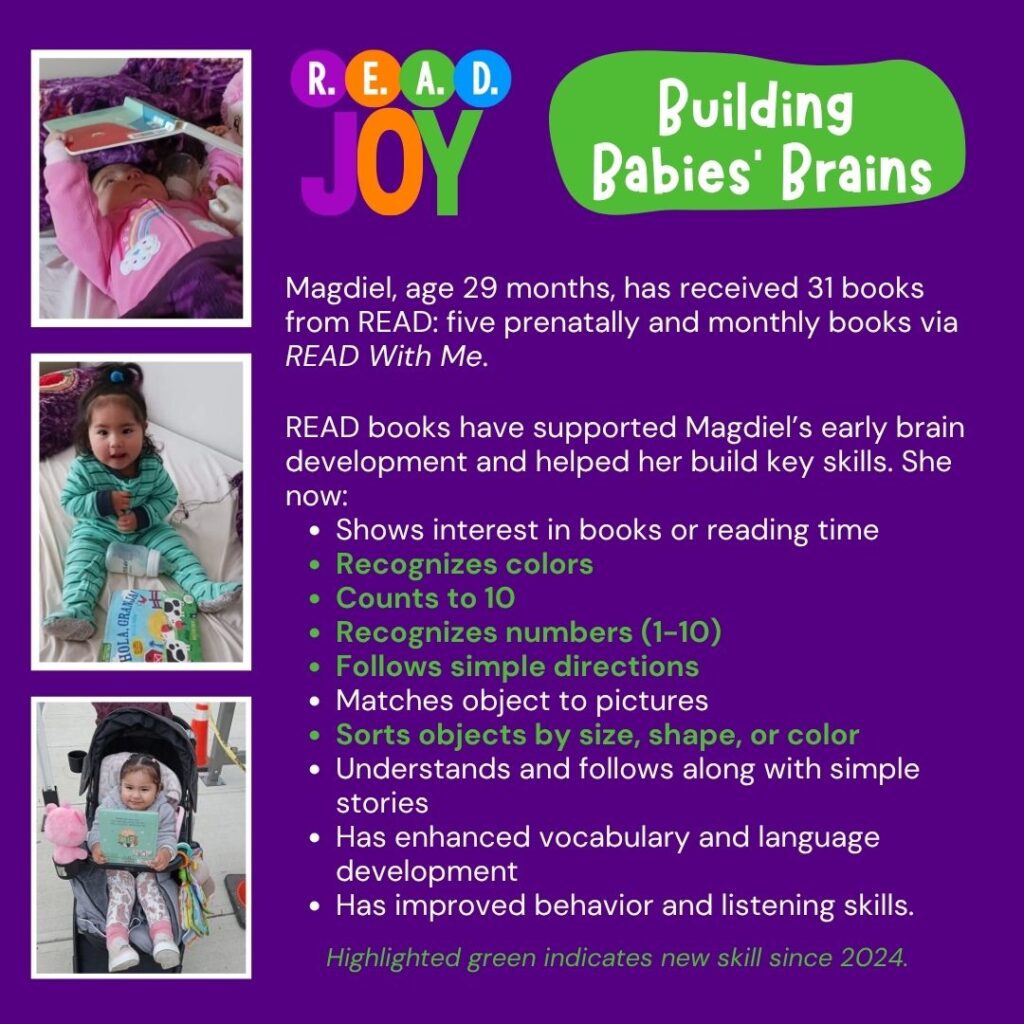
Lucas, age 33 months, has received 38 books from READ: five prenatally and monthly books via READ With Me. READ books have supported Lucas’ early brain development and helped him build key skills. He now:
- Shows interest in books or reading time
- Recognizes colors
- Recognizes basic shapes
- Knows the ABCs and identifies individual letters
- Counts to 10
- Recognizes numbers (1-10)
- Follows simple directions
- Matches object to pictures
- Sorts objects by size, shape, or color
- Speaks in full sentences
- Understands and follows along with simple stories
What ways can the public get involved?
Email clairemorris@readearlyanddaily.org for more information and to sign up to volunteer.
How are charitable dollars spent? Where does my donation go?
Our model is simple. READ gets free, quality, culturally relevant books to vulnerable babies when they need them the most. You can choose to help one baby or many babies.
- $100 helps build and *light up* one baby’s brain
- $500 helps build and *light up* five babies’ brains
- $1000 helps build and *light up* ten babies’ brains
When you support READ, YOU are enhancing the literacy and language experiences of economically vulnerable babies and toddlers at their most vital brain development by providing books for them to keep and for parents to read aloud. These early simple acts of reading together sets a baby on the path to future academic success and self-sufficiency.
Information provided March 2026
Friends of the Mount Vernon Trail
 Friends of the Mount Vernon Trail
EIN: 83-4129792
Mission Statement
The Friends of the Mount Vernon Trail supports the National Park Service in keeping the trail safe and welcoming for all users through education, trail maintenance, and community events.
Program Summary
The Mount Vernon Trail is an 18-mile long shared use path that travels along the George Washington Memorial Parkway in Northern Virginia between Rosslyn and George Washington’s home at Mount Vernon. The Friends of the Mount Vernon Trail (FoMVT) was formed in 2018 and supports the National Park Service in keeping the trail safe and welcoming for all users through education, trail maintenance, and community events.
The Friends of the Mount Vernon Trail hold regular volunteering activities for the public. All are welcome to attend, no experience necessary, and kid-friendly.
Impact Statement
FoMVT believes that the Mount Vernon Trail and the George Washington Memorial Parkway should be enjoyed by everyone and that everyone should be given the opportunity to be a steward of the park. Volunteers have ranged in age from 2 to 85 years old. Weekly volunteer events do not have a participant cap and have been as large as 160 participants. Since 2018, the FoMVT have hosted over 300 volunteer events with over 7,000 volunteers giving back to the trail.
What ways can the public get involved?
We host volunteer events every Saturday on the trail. You can see a list of upcoming events on our website at https://mountvernontrail.org/events/
We also host resource appreciation events such as an annual Tulip Walk/Bike Ride, Bat and Firefly Walk, Beaver Moon Walk, and various art classes.
How are charitable dollars spent? Where does my donation go?
The largest overhead cost of the organization is paying for the storage of tools and equipment. We also use donations to purchase new tools, signs, fencing, maintenance of trail fixing equipment, and cold patch to fill potholes.

Information provided March 2026
Shirlington Employment and Education Center (SEEC)
 Shirlington Employment and Education Center (SEEC)
EIN: 54-2036192
Mission Statement
SEEC’s mission is to raise the standard of low-wage, immigrant day laborers in Arlington County so that Day Laborers and other immigrant workers can participate in dignified work, in safe working conditions, and earn fair wages. We provide an opportunity for Day Laborer to find safe work at a fair wage and to obtain skills that improve their employability and we work to improve the overall conditions of day Laborers in Arlington.
Program Summary
SEEC provides services to Day Laborers – workers who provide a critical temporary labor force for local construction, food, janitorial, moving support and landscaping businesses, without whom these businesses could not survive. Arlington’s Day Laborers are majority Latino (over 95%) recently immigrated men, over 95%, who are unable to obtain or maintain permanent part-or full-time employment.
The majority of SEEC’s clients are from Zip Codes 22204 and 22206; over 70% are from 22204. As recent lone immigrants, most have little or no familial support in the area and lack English language skills, which presents a barrier to employment. These Laborers are extremely low- to no income workers who present with immediate critical needs for jobs, food, housing, emergency funds, and medical care. In FY 2024, 80% fit the criteria for homelessness; 90%
reported food insecurity; and approximately one third required referral to the Arlington Free Clinic ( AFC). In a society that often fears single Latinos and men of color congregating in public places and who resemble – or are – homeless and unemployed, historically marginalized, Day Laborers face a significant amount of institutional, systemic, and individual discrimination, are often isolated, and require protection from the illegal labor practices and exploitation encountered on job sites.
Impact Statement
SEEC provided vital services to the immigrant community that included:
- Serving 749 laborers
- Filled 689 jobs
- Resolved 12 cases of wage theft
- Prevented 30 evictions
- Distributed 2,200 free brown bag meals
- Referred 108 Day Laborers to the Arlington Free Clinic
- Referred 259 Day Laborers to the Arlington Food Assistance Center
- Provided 650 monthly hot meals through the SEEC Winter Hot Meal Initiative
- Inaugurated the SEEC Emergency Needs Fund and the SEEC Saturday Legal Clinic, which aids with immigration issues
What ways can the public get involved?
We invite volunteers who can tutor English to our clients.
We need volunteers to provide transportation to take day laborers to local jobs.
We invite volunteers to provide bag lunches for the day labores.
How are charitable dollars spent? Where does my donation go?
Over 95% of the charitable donations go to pay for training and support for the day laborers. This includes paying for temporary rent, bus transportation, for the cell phones that are essential to communicating with employers, prescription drugs and meals for those who can’t find work and are going hungry.
Information provided March 2026
Jennifer Bush-Lawson Foundation
 Jennifer Bush-Lawson Foundation
EIN: 47-1374686
Mission Statement
The Jennifer Bush-Lawson Foundation serves economically vulnerable mothers and babies by increasing access to much-needed health care support, conducting research to affect systemic change, and ensuring they have the supplies needed to bring baby home. In honor of Jennifer Lawson, a loving mother of three who tragically lost her life in 2014, we aim to honor her dedication, generosity, and kind heart by fulfilling the vision that she crafted for every mother and baby in need.
Program Summary
We have 3 primary initiatives to accomplish our mission. The first is to ensure families have everything they need to bring baby home safely – from cribs to car seats. The second is to increase access to quality care by funding innovative pilots – such as tele-health – that enable these families to access care that meets their daily needs. The third is to raise awareness of the issues facing this community through thought leader events and social media promotion.
Impact Statement
Throughout our 9-year history we have served more than 3,000 families, provided more than 350 basics materials, hosted 10 awareness campaigns, and funded more than $250,000 to support Including projects focused on infant care, tele-health, & maternal mental health. In addition to these mission related activities, we strive to be nimble in an ever-changing environment to help these families in other important ways. For example, in 2020 we launched a program to put kitchen staff back to work while delivering home cooked meals to new mothers whose family were affected by the economic shutdowns.
What ways can the public get involved?
We have two ways of getting involved with the Jennifer Bush-Lawson Foundation. Volunteer throughout the year by helping us collect gently used baby supplies such as car seats, strollers, and portable cribs. In addition, our signature fundraising event, the 5K and Family Fun day is always in need of volunteers. This event is held the Saturday before Thanksgiving at the Knights of Columbus.
How are charitable dollars spent? Where does my donation go?
The Jennifer Bush-Lawson Foundation is giving economically vulnerable mothers and babies renewed hope by increasing access to much-needed health care support, conducting research to affect systemic change, and ensuring they have the supplies needed to bring baby home. Your support changes lives.
$25 helps provide a breastfeeding starter pack
$50 helps provide a portable crib
$100 helps provide a car seat
Information provided March 2025
Meals on Wheels of Arlington
 Meals on Wheels of Arlington
EIN: 52-1344727
Mission Statement
At Meals on Wheels Arlington, our mission is to nourish and empower homebound individuals in Arlington by providing wholesome, prepared meals with compassion and care. We believe that everyone deserves access to nutritious food and the comfort of connection. Through our dedicated volunteers and community partnerships, we strive to enhance the well-being and dignity of those we serve, fostering a sense of belonging and support for all. Together, we are creating a healthier, more inclusive community where no one faces hunger alone.
Program Summary
Potential clients are referred to the Arlington County Agency on Aging for eligibility intake. For accepted clients, meals are prepared by a commercial caterer and delivered to our staging area at First Presbyterian Church on Vermont Avenue in the Ballston neighborhood. Volunteer drivers pick up the meals and deliver them to homebound residents in North and South Arlington. Most clients receive 10 meals delivered once a week, along with beverages. A small group who cannot accommodate a bulk delivery receive two meals, five days a week, plus beverages. We currently serve about 180 clients each week. First Presbyterian Church allows us to use their facility for staging and storage, but we do not have a permanent physical address.
Impact Statement
In 2024, volunteers from our 139 person roster devoted 7000 hours delivering 93,000 meals to 290 individual client. Meals are delivered either weekly or daily, depending on need. Meals on Wheels Arlington addresses food insecurity for Arlington residents who are over 60 and unable to manage food preparation on their own. Meals on Wheels Arlington also serves Arlington residents under age 60, who, because of their age cannot be funded through the Arlington Agency on Aging. MOW uses its own funds to support these individuals. These are Arlington residents who are homebound and unable to provide food for themselves. These are Arlington residents who are homebound and unable to provide food for themselves who would otherwise fall through the cracks of Arlington’s excellent programs.
An added benefit to our program is that because MOW drivers have regular contact with our clients, they can be our eyes on the ground. In the event they see something that would affect a client’s health or safety, MOW will communicate these concerns to Arlington County, for follow up by a social worker.
What ways can the public get involved?
Of course, members of the public are welcome to donate to our organization with funds as well as volunteering. Members of the public can help us out by volunteering to drive meals to our clients or load the driver’s vehicles.
Volunteer drivers are the engines that move us! In a month, we deliver over 7,700 meals through approximately 35 routes averaging 5-8 clients per route. The majority of our delivery activity occurs on Wednesdays. We do not deliver evenings or weekends. We ask our drivers to be available at least once a month. The time commitment to drive a route is about 2.5 hours and requires use of the driver’s own vehicle.
How are charitable dollars spent? Where does my donation go?
As a volunteer-driven organization with an overhead rate of less than 1%, donations directly fund mission-related needs. Most of our donation dollars are directed toward funding meals for homebound clients who do not meet Arlington County’s age requirement of 60 and who cannot afford to pay for meals on their own. $62 funds meals for a week for a homebound Arlington resident. Donations allow us to add clients to our roles.
Though we are affiliated with Meals on Wheels America, we receive no funding from the national organization. Meals on Wheels Arlington is fully locally funded and managed.
Information provided March 2025