
organization-leadership: Women-led
 Greater DC Diaper Bank
 Greater DC Diaper Bank
EIN: 27-4276547
Mission Statement
Greater DC Diaper Bank supports vulnerable families across DC, Maryland, and Virginia by providing diapers and other critical hygiene items, and expanding access to essential services for those who need them most.
Program Summary
In collaboration with our partner network, we execute the following programs:
- Diaper Collection and Distribution Diapers are secured through in-kind donations and discounted wholesale purchases. Distribution partners receive 5,000–40,000 diapers each month. Because of our purchasing power, we can buy two diapers for the cost of one in stores.
- The Baby Pantry Established in 2014, the Baby Pantry distributes formula, wipes, baby food, and essential hygiene items for babies, teens, and adults. These include body wash, shampoo, deodorant, toothpaste, period products, and adult incontinence supplies.
- The Monthly Launched in 2016, this program provides menstrual products to those experiencing period poverty and is distributed through our Baby Pantry.
- The Nursery Project Established in 2017, the program provides bundles of baby gear that promote safe sleep, play, and travel, including cribs, strollers, and car seats.
Impact Statement
Greater DC Diaper Bank (GDCDB) continues to lead the charge as the largest diaper bank in the DC region and one of the largest nationwide. Distributing diapers, formula, baby food, period products, and other hygiene essentials through partners across DC, Maryland, and Virginia, we’re making a powerful impact by reaching families in 375 zip codes.
In 2024, we increased our regional service level from meeting 20% of the diaper need to 23%-a result of both operational improvements and strategic growth-to reach record levels of impact.
This growth was made possible by the addition of eight new community partners located in geographic areas of the highest levels of unmet diaper need. These data-driven programmatic decisions had a ripple effect—expanding our geographic reach, increasing equity in distribution, and deepening relationships across our community.
We distributed 10.2 million diapers, turning a value of over $4.02 million back to local families!
Our programs – The Baby Pantry, The Nursery Project, and The Monthly – provide basic needs items beyond diapers. In 2024, the value of these items provided to families for free was nearly $1 million.
In addition, we served 46,740 babies and 39,800 families, increasing service levels by 11%and 8%, respectively, over 2023.
What ways can the public get involved?
Give
- Give Items: We accept items for families at our warehouse and around the region! Visit greaterdcdiaperbank.org/donate-in-your-neighborhood
- Give Dollars: Financial support makes our work possible! Make your donation any time at greaterdcdiaperbank.org/give-dollars. For every $1 you spend on diapers at the store, we can buy two!
Volunteer
- On-Site: We welcome dozens of volunteers to our Silver Spring, MD warehouse each week! Visit greaterdcdiaperbank.org/volunteer to sign up today! All opportunities are family friendly and all ages are welcome.
- At Work: Our new Mobile Volunteer Program gives employers the chance to bring GDCDB to you! Visit greaterdcdiaperbank.org/mvp to learn more!
How are charitable dollars spent? Where does my donation go?
When you give to Greater DC Diaper Bank, your dollars go twice as far, every day. For every $1 donated, we can purchase two diapers through our wholesaler—twice as many as you’d be able to buy at a store.
Your dollars help us purchase hygiene supplies such as diapers and wipes, and support our programs including the Baby Pantry and Nursery Project. Financial support enables us to flexibly respond to the community’s most urgent hygiene needs and leverage our wholesale and corporate relationships for greater purchasing power and to ensure your dollars go as far as possible.

Information provided April 2025
CARE, Inc.
 CARE, Inc.
EIN: 54-1807476
Mission Statement
CARE, Inc. mobilizes partnerships and community leadership to connect people with resources, opportunities, and support systems that strengthen families, enrich lives, and build a more inclusive and economically vibrant community.
We foster trust, cultivate collaboration, and deliver impactful programs that advance education, economic empowerment, and community well-being.
Program Summary
CARE, Inc. (Community Association of Resources, Education, Enrichment & Economics) is a community-rooted nonprofit dedicated to strengthening families and advancing underserved communities.
We serve as a trusted connector—bringing together residents, service providers, local businesses, and strategic partners to build a more equitable, resilient, and thriving community. Through collaborative initiatives, including the Green Valley Farmers Market, we expand access to fresh food, economic opportunity, youth development, and supportive services that uplift generations.
Our work is grounded in relationships, driven by community voice, and focused on creating sustainable systems that support health, stability, and long-term prosperity.
CORE PROGRAM AREAS
🥕 1. Green Valley Farmers Market (Food Access + Economic Development)
- Weekly seasonal farmers market in a historically underserved community
- Increases access to fresh, culturally relevant foods
- Supports local farmers, small businesses, and entrepreneurs
- SNAP/EBT access and healthy food incentives (planned/expanding)
🚲 2. Youth Development & Workforce Pipeline (Ages 10–18)
- Gardening Apprenticeship Program (GAP)
- Financial literacy, entrepreneurship, and job readiness training
- Youth-run market participation (vendors, operations, leadership roles)
- Summer internships and community service engagement
👵🏽 3. Seniors & Aging in Place
- Food access support through market and delivery options (developing)
- Resource navigation for housing, health, and social services
- Community connection to reduce isolation
- Advocacy for affordable housing and aging-in-place solutions
COMMUNITY NEED
- Limited access to fresh, affordable food in historically underserved neighborhoods
- Youth lacking structured workforce development and leadership opportunities
- Seniors facing housing instability, isolation, and barriers to services
- Fragmented service systems that require stronger coordination and trust
CARE addresses these gaps through integrated, place-based solutions that meet people where they are.
Impact Statement
We build community-led solutions that strengthen families, reduce inequities, and create sustainable pathways to opportunity.
🎯 Our Focus Areas
Food Access & Economic Opportunity
Green Valley Farmers Market
- Fresh, culturally relevant food access
- Local vendor & small business support
- Youth entrepreneurship opportunities
Youth Development (Ages 5–10) — Early Foundations Program
- Literacy enrichment & reading engagement
- Social-emotional learning (SEL) & confidence building
- Nutrition education & healthy habits (linked to Farmers Market)
- Creative arts, storytelling & cultural identity
- Safe, structured enrichment in community spaces
Youth Development (Ages 10–18)
- Workforce readiness & leadership training
- Hands-on entrepreneurship (market vendors, internships)
- Mentorship & community engagement
Aging in Place (NEW 2026 Initiative)
- Volunteer caregiving & companionship
- Transportation, meals, and home support
- Reducing senior isolation and housing instability
What ways can the public get involved?
🌿 Public Engagement Strategy for CARE, Inc. Programs
🤝 1. Volunteer Pathways (Entry → Leadership)
Create clear, flexible ways for people to get involved immediately:
Entry-Level (Easy On-Ramp)
- One-day service events (farmers market setup, senior home clean-ups)
- “Bring-a-friend” volunteer days
- Youth + family volunteer opportunities
Ongoing Roles
- Senior companions (“Adopt-a-Grandparent” model)
- Market ambassadors & greeters
- Youth mentors & reading buddies (ages 5–10 program)
Leadership Roles
- Volunteer team leads
- Community captains by neighborhood
- Advisory committee members
🧒🏽 2. Family & Intergenerational Programming
Bring the whole community together—not just individuals.
- “Kids & Seniors Together” days (reading, storytelling, cooking)
- Family volunteer days at the farmers market
- Youth teaching seniors tech basics (phones, apps, telehealth)
- Community gardening days
🥬 3. Community Events as Engagement Hubs
Use events as entry points into deeper involvement
- Green Valley Farmers Market activations:
- Health screenings
- Cooking demos
- Youth vendor showcases
- Seasonal events (Back-to-School, Senior Appreciation Days)
- “Community Care Days” in neighborhoods
🗣 4. Community Voice & Co-Design
Let residents help shape the programs
- Quarterly community listening sessions
- Surveys (paper + QR code at events)
- Youth advisory council
- Senior advisory group
📣 5. Faith & Community Partnerships
Leverage trusted institutions
- Partner with churches for:
- Volunteer recruitment
- Senior outreach
- Space for programs
- Collaborate with schools for youth engagement
- Engage local businesses as sponsors + volunteers
📱 6. Digital Engagement (Simple + Consistent)
Meet people where they already are:
- Monthly email/newsletter: “CARE in Action”
- Social media:
- Volunteer spotlights
- Senior stories
- Youth success highlights
- Text reminders for events and volunteer shifts
🎓 7. Skill-Based & Corporate Volunteering
Tap into professional talent:
- Handymen → senior home repairs
- Accountants → financial literacy workshops
- Chefs → cooking demos
- Corporate teams → service days
🧾 8. Public Recognition & Storytelling
People stay involved when they feel valued
- Volunteer of the Month
- Youth achievement showcases
- Senior stories (“Legacy Voices of Green Valley”)
- Social media + event recognition
How are charitable dollars spent? Where does my donation go?
The majority of funds directly support community programs:
Food Access & Farmers Market
- Fresh food distribution and access initiatives
- Market operations (permits, equipment, logistics)
- Vendor support and small business development
Youth Development (Ages 5–18)
- Educational materials, books, and supplies
- Youth stipends and workforce training
- Mentorship programs and enrichment activities
Aging in Place (Senior Support)
- Transportation assistance and meal support
- Volunteer coordination for caregiving services
- Basic home support (supplies, minor repairs)
CARE, Inc. invests charitable dollars where they matter most—directly into people, programs, and community solutions—while maintaining lean operations and measurable impact. We work mostly with volunteers and pay stipends for our Interns.

Information provided March 2026
OAR of Arlington, Alexandria and Falls Church
 OAR of Arlington, Alexandria and Falls Church
EIN: 54-1024562
Mission Statement
OAR is a community-based nonprofit organization that envisions a safe and thriving community where those impacted by the legal system enjoy equal civil and human rights. Through our Upstream work, we are confronting and dismantling individual racism and racism in the legal system and across all systems. Our Downstream work allows us to be on the journey with individuals of all genders returning from incarceration and their families. We also offer alternative sentencing options (including community service) and diversion programs so people can avoid the trauma of incarceration and instead help the community thrive.
Program Summary
OAR Upstream:
Racial Justice + Liberation
We lift the voices of Black, Indigenous, Latinx/e/o/a, Asian, and Mulitcultural (BILAM) people who have experienced racism and other intersecting forms of marginalization and challenge white people (WP) and those who have benefited from personal and systemic racism to become leaders in dismantling injustice and redressing the harm caused by personal racism. Efforts include facilitating multiple intensive virtual learning cohorts for community members and especially those working in law enforcement and the criminal legal system that address liberation and dismantling whiteness.
OAR Downstream:
Reentry Services
We work with individuals at the Arlington County Detention Facility, the Adult Detention Center in the City of Alexandria, the closest Virginia state prison, and other correctional facilities who are preparing to return to the community and who come back to Arlington, Alexandria, and Falls Church. We also journey with their families before and after release. Our efforts in facilities include pre-release workshops focused on reentry issues, health and wellness, group psychotherapy, and transition planning. After release, we provide direct services (such as housing assistance, clothing, transportation, smartphones, laptops, debt repayment, and ongoing help with rent and other expenses), offer a comprehensive Employment Program, and facilitate an ongoing weekly virtual support group for program participants. OAR also established a pilot, gender-responsive, clinical services initiative providing a range of reentry services specifically tailored for individuals identifying as women/female/femme who are coming home to the community after experiencing incarceration.
Alternative Sentencing + Diversion
OAR works with Arlington County and the City of Falls Church Courts to provide alternative sentencing and diversion programs. OAR’s community service program allows individuals to do volunteer work in the community in lieu of jail time and fines, to work off their accrued court costs, and also pay court costs. OAR is implementing a Diversion program in partnership with the Vera Institute and Office of the Commonwealth’s Attorney – Arlington County and the City of Falls Church with the goal of reducing recidivism as well as racial disparities amongst individuals sentenced to diversion programs. (by 20% each year)
Impact Statement
OAR is a Collective, non-dominant, decolonizing, pro-Black, racially just, radically joyful, deeply loving, come as you are, liberated organization that puts participants first. We center authentic and fully engaged relationships with all members of the OAR community. Our goals include partnering with those who have experienced incarceration so they can create a safe reentry for themselves and preventing other individuals from enduring that trauma through alternative sentencing programs. With our upstream social justice work, we hope to spur the type of pro-Black racial justice activism that will help ensure that no one will need our social services and OAR no longer needs to exist 50 years from now.
How are charitable dollars spent? Where does my donation go?
- $50 – Provides a stipend to a child of an OAR participant impacted by incarceration
- $100 – Provides 1 month transportation/metro fare for OAR participant(s)
- $250 – Cover ID retrieval for OAR participant(s) needed to secure housing
- $500 – Covers up to three months of coaching for an OAR participant(s)
- $1,000 – Provides up to one month of rent for at least an OAR participant(s)
- $2,500 – Provides up to 90 days worth of reentry services for OAR participant(s)

Information provided March 2026
Rosie Riveters
 Rosie Riveters
EIN: 47-4710197
Mission Statement
Rosie Riveters, a 501(c)(3) nonprofit, works to close the gaps in today’s workforce by increasing participation in STEM, fostering critical thinking and problem-solving skills to develop the innovators of tomorrow.
Program Summary
Rosie Riveters offers hands-on STEM programs that foster confidence through productive struggle, critical thinking, and problem-solving. Designed for flexibility, its K-8 projects adapt to various settings—whether a 45-minute classroom lesson or a two-hour group experience—making STEM learning accessible in classrooms, military family programs, and community events. The high school program, Rosie Innovators (9-12), builds on this foundation, deepening STEM engagement and preparing participants for future education and careers.
Impact Statement
Since our inception in 2016, we have had the privilege of serving over 20,000 participants, witnessing remarkable outcomes with 96% of our participants enjoying the program and 89% being inspired to further explore STEM.
What ways can the public get involved?
You can get involved with Rosie Riveters in a few impactful ways! Volunteer your time by helping with quarterly STEM programs, packing STEM kits, or supporting events. If you’d rather contribute financially, donations go a long way in expanding programs and reaching more girls. Businesses and organizations can also partner by sponsoring programs, matching employee donations, or getting teams involved in volunteer activities. Want to stay in the loop? Subscribe to our mailing list for updates and event info. However you choose to help, you’ll be making a real difference in inspiring the next generation in STEM https://rosieriveters.org/volunteer/
How are charitable dollars spent? Where does my donation go?
At Rosie Riveters, every charitable dollar goes directly toward providing hands-on STEM experiences for students. Thanks to generous donations, we’ve served over 35,000 participants, giving them the opportunity to build confidence and critical thinking skills through engaging STEM projects. Your support helps fund program materials, STEM kits, educator resources, and expansion efforts to reach even more future innovators. Every contribution makes a tangible impact in inspiring the next generation of women in STEM!

Information provided March 2025
Read Early and Daily (READ)
 Read Early and Daily (READ)
EIN: 82-3345797
Mission Statement
Ensuring babies and young children have new, quality, culturally relevant books of their own that are mirrors and windows into their everyday lives and communities
Program Summary
FACT: All babies are born with the same number of neurons…BILLIONS.
FACT: Neurons are pretty much useless unless they make a connection (aka synapse).
FACT: Connections are made through talking, singing, cuddling, and most importantly, READING books with your baby.
Every time a book is read to a baby, a connection is made in their brain, that is, a neuron is activated (*lit up*). Isn’t that amazing?! It’s that simple.
BUT without books in the home, reading to babies and young children every day is nearly impossible.
- On average, children from low-income families have 1 book compared to 12 books that their peers from middle income families have.
- As a result, these young children hear 25 hours of 1-to-1 reading before school while children from middle-income families hear 1,000 hours of listening to books read aloud.
- By age 3, a child from a low-income family has a listening vocabulary of 500 words, compared to 1,100 for their peers from middle-income families.
- Arriving at school, they score 60% lower on cognitive tests and lag 12-14 months behind in language and pre-reading skills.
READ was created to address reading inequities faced by Arlington’s youngest and most economically vulnerable children. We meet expectant, uninsured families at their prenatal appointments and start them off with a baby book bag filled with five board books plus tips for reading. When the baby is born, they are automatically enrolled in our cornerstone program READ With Me and receive a texted order form for a new FREE, quality, culturally relevant book each month for their baby’s first year. In addition, they receive monthly reading texts and tips.
Impact Statement
In 2025, over 500 babies and toddlers from economically vulnerable families participated in our cornerstone program READ With Me, allowing their families to choose and receive a new, quality, age-appropriate, culturally relevant book every month. Our 2024 parent survey indicated:
- 100% of families report READ With Me has helped them build a home library
- 99% of families report spending more time reading with their baby.
- 97% of families report they have made reading part of their daily routine
- 99% of families report their child has learned new words and/or new information from the books.
- Over 50% of our families report READ is their only source of books
One family’s story
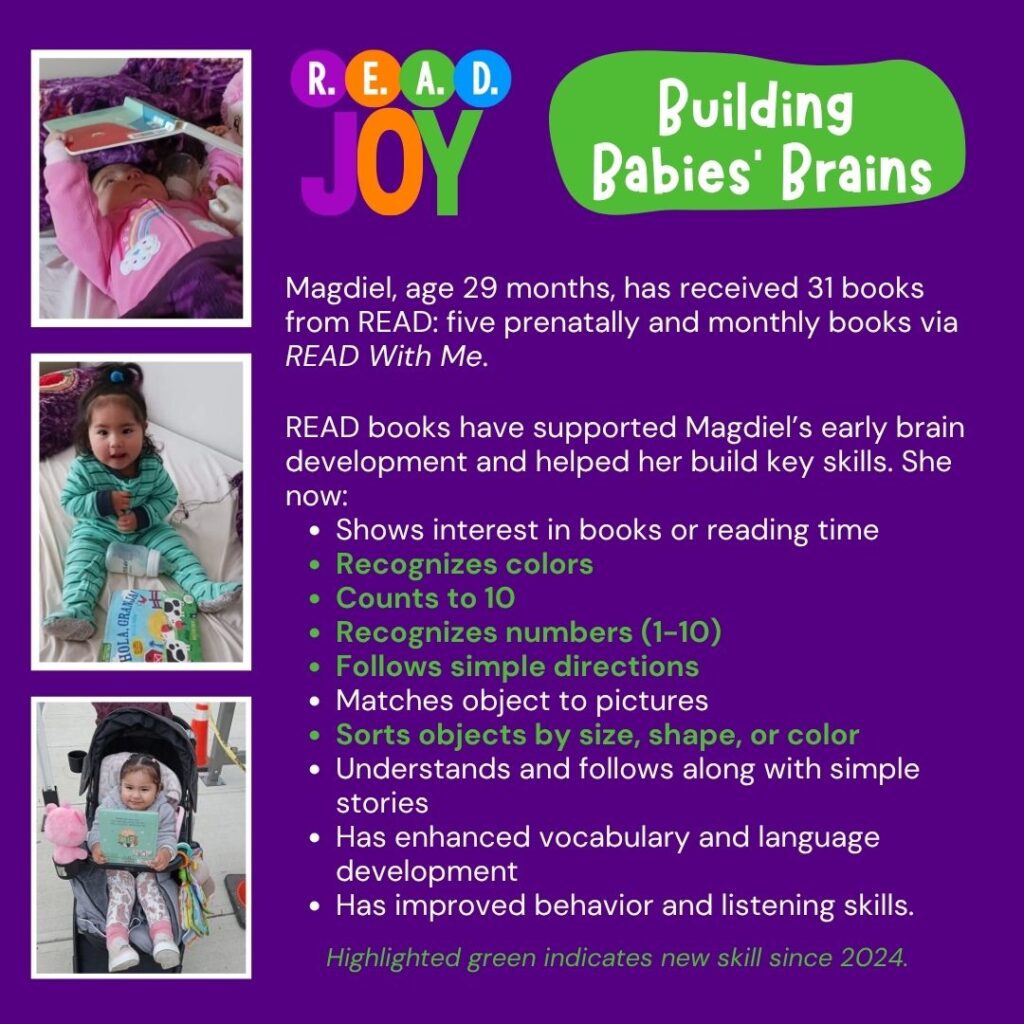
Lucas, age 33 months, has received 38 books from READ: five prenatally and monthly books via READ With Me. READ books have supported Lucas’ early brain development and helped him build key skills. He now:
- Shows interest in books or reading time
- Recognizes colors
- Recognizes basic shapes
- Knows the ABCs and identifies individual letters
- Counts to 10
- Recognizes numbers (1-10)
- Follows simple directions
- Matches object to pictures
- Sorts objects by size, shape, or color
- Speaks in full sentences
- Understands and follows along with simple stories
What ways can the public get involved?
Email clairemorris@readearlyanddaily.org for more information and to sign up to volunteer.
How are charitable dollars spent? Where does my donation go?
Our model is simple. READ gets free, quality, culturally relevant books to vulnerable babies when they need them the most. You can choose to help one baby or many babies.
- $100 helps build and *light up* one baby’s brain
- $500 helps build and *light up* five babies’ brains
- $1000 helps build and *light up* ten babies’ brains
When you support READ, YOU are enhancing the literacy and language experiences of economically vulnerable babies and toddlers at their most vital brain development by providing books for them to keep and for parents to read aloud. These early simple acts of reading together sets a baby on the path to future academic success and self-sufficiency.
Information provided March 2026
Jennifer Bush-Lawson Foundation
 Jennifer Bush-Lawson Foundation
EIN: 47-1374686
Mission Statement
The Jennifer Bush-Lawson Foundation serves economically vulnerable mothers and babies by increasing access to much-needed health care support, conducting research to affect systemic change, and ensuring they have the supplies needed to bring baby home. In honor of Jennifer Lawson, a loving mother of three who tragically lost her life in 2014, we aim to honor her dedication, generosity, and kind heart by fulfilling the vision that she crafted for every mother and baby in need.
Program Summary
We have 3 primary initiatives to accomplish our mission. The first is to ensure families have everything they need to bring baby home safely – from cribs to car seats. The second is to increase access to quality care by funding innovative pilots – such as tele-health – that enable these families to access care that meets their daily needs. The third is to raise awareness of the issues facing this community through thought leader events and social media promotion.
Impact Statement
Throughout our 9-year history we have served more than 3,000 families, provided more than 350 basics materials, hosted 10 awareness campaigns, and funded more than $250,000 to support Including projects focused on infant care, tele-health, & maternal mental health. In addition to these mission related activities, we strive to be nimble in an ever-changing environment to help these families in other important ways. For example, in 2020 we launched a program to put kitchen staff back to work while delivering home cooked meals to new mothers whose family were affected by the economic shutdowns.
What ways can the public get involved?
We have two ways of getting involved with the Jennifer Bush-Lawson Foundation. Volunteer throughout the year by helping us collect gently used baby supplies such as car seats, strollers, and portable cribs. In addition, our signature fundraising event, the 5K and Family Fun day is always in need of volunteers. This event is held the Saturday before Thanksgiving at the Knights of Columbus.
How are charitable dollars spent? Where does my donation go?
The Jennifer Bush-Lawson Foundation is giving economically vulnerable mothers and babies renewed hope by increasing access to much-needed health care support, conducting research to affect systemic change, and ensuring they have the supplies needed to bring baby home. Your support changes lives.
$25 helps provide a breastfeeding starter pack
$50 helps provide a portable crib
$100 helps provide a car seat
Information provided March 2025
Challenging Racism
 Challenging Racism
EIN: 81-2305195
Mission Statement
To empower and inspire people to disrupt racism one compassionate conversation at a time.
Program Summary
Challenging Racism (CR) is an Arlington-based 501(c)3 and our mission is to empower and inspire people to disrupt racism one compassionate conversation at a time. For more than 20 years, we have trained organizations and individuals using professionally designed and facilitated programs to build awareness and skills to courageously talk about race and equity. We offer introductory programs, topic-specific workshops, book/podcast/movie discussions, and facilitator training. We also provide DEIBA (diversity, equity, inclusion, belonging and accessibility) advisory services for organizations to effectively disrupt all “-isms” in the workplace.
Our approach is based on conversations and storytelling, rooted in facts and local history, to create a shared experience that dispels dangerous myths and assumptions. We invest the time and self-reflection needed to build deep knowledge, skills, and practice to normalize conversations on race and othering, and to hold the difficult conversations necessary to advance systems-level change.
We serve diverse participants from a wide range of local partners including government, schools, non-profits, faith groups, theatre companies, and the private sector. We build the capacity of the organizations we engage with so that they can assess and lead their own social and racial equity programs, and our alumni go on to act as change agents in the community.
Challenging Racism is a ”small but mighty” non-profit organization, dedicated to advancing intersectional anti-biased and anti-racist work in our diverse but segregated communities across Washington DC, Maryland, and Virginia (DMV). We are Black-led, staffed majority by women, and benefit from the guidance and wisdom of our talented and diverse Board.
Impact Statement
We center race because racial inequities exist in every system: health, education, criminal justice, employment, and more. We center intersectionality because racial disparities persist across all identities: gender, sexuality, education, ability, age, socioeconomic, citizenship, and more.
Most Americans lack racial literacy and conversational practice to effectively impact these inequities and disparities. Our workshops move participants from a misconception that discrimination, bias, and racism is simply the work of “bad individuals” to an understanding that racism is systemic. Moreover, it is a system of advantage that all of us participate in whether we intend to or not, and we can work to eliminate their consequences by working for equity.
Our participant surveys reveal behavior change in our participants after they learn about the root causes of inequities and types of bias. Our participants report a greater likelihood of recognizing and interrupting harmful microaggressions which results in a safer, more inclusive community for BIPOC (Black, Indigenous, People of Color) populations. In the workplace, we have observed organizations adopt an equity lens necessary to identify and challenge discriminatory practices, attract increased staff diversity, and successfully foster authentic relationships with BIPOC colleagues and beneficiaries. These impacts are measurable and necessary for systems-level change.
What ways can the public get involved?
Challenging Racism enthusiastically welcomes the public to join our programs as participants or serve as hosts of a Challenging Racism program in your community or workplace. Every program we facilitate helps build awareness and community power where advocacy and action for racial and economic justice are most needed today.
We also welcome volunteers to join us as we design and implement a range of outreach activities to support racial equity and anti-racism. Our volunteers help plan events, build partnerships, outreach via social media, apply for grants, raise funds, and design programs for organizations needing our conversations. All skills are needed and volunteers can choose to help with discrete activities or lead on racial equity initiatives. Interested volunteers can fill out our Volunteer Form on our website or contact us for more information at info@challengingracism.org.
How are charitable dollars spent? Where does my donation go?
Interest in our racial equity and DEIBA workshops has never been stronger. However, members of our larger community are left out because of tuition costs, which are required to sustain our organization, pay our professionally-trained racial equity facilitators, and fund the highest quality curriculum writing.
Contributions make our conversations and workshops more available to every member of our community and more affordable to passionate, committed, and diverse participants. Your donation enables local leaders and community members from diverse backgrounds to strengthen their facilitation and advocacy skills for racial equity and to go on to teach others and disrupt and dismantle systemic racism across our community.

Information provided March 2025
Wesley Housing
 Wesley Housing
EIN: 51-0155779
Mission Statement
Wesley Housing’s mission is to build up communities with quality affordable housing and resident services.
Program Summary
Beyond building/preserving permanent housing options for persons with low- and moderate-incomes across Virginia and Washington, DC, we strive for our housing to be a foundation to thrive. We do this by offering free support services/education to every to guide residents on their paths to self-sufficiency. As such, our core lines of business are real estate development, asset management, and resident services.
Through our Housing Stability Initiative (HSI), the basis of our award-winning resident services programming, Wesley Housing provides supportive services residents on-site in their communities, including 380 households in Arlington. The Initiative operates on the basis that housing is the foundation families need to thrive, and once stabilized, families can build up other aspects of their lives. As such, in addition to eviction prevention support, the HSI also provides workforce development opportunities, health/wellness offerings, and household assistance.
Impact Statement
For more than 50 years, Wesley Housing has provided permanent, affordable housing to generations of people experiencing financial insecurity.
Today, we own 43 communities home to 5,300 residents, including multi-family apartments and communities for older adults/individuals with disabilities/chronic disease. Five of these communities are located in Arlington County and are home to 816 residents, 87% of which are BIPOC and earn $37,458/year on average.
At the same time, we are still rapidly expanding. Our Real Estate team has 1,000+ affordable units in its development pipeline, including new construction and renovations, such as the Melwood-Wesley Inclusive Community in Arlington.
The impact we make each year is measured by the success of our residents. In 2025, 395 residents accessed linkage and referral services. Through the work of our resident services team, 66 evictions were prevented, 20 residents received new/more gainful employment, 294 residents participated in health/wellness offerings, and 1,453 residents received household assistance (i.e. food/hygiene items). This summer, we served 258 youth through Quest summer camp, and launched Odyssey for older adults, engaging 149 participants. In addition, 606 K-12 students received new backpacks and supplies through Supplies for Success, and 789 residents received holiday assistance through Holiday Help.
What ways can the public get involved?
Wesley Housing welcomes support of our major giving campaigns throughout the year including the Housing Stability Initiative (year-round), QUEST Summer Youth Enrichment Program (April/May), Back-to-School (July/Aug), and Holiday Help (Nov-Dec).
In addition, volunteers serve in many capacities including youth and adult education assistants and tutors; translators; holiday helpers (gift wrappers, sorters) and delivery drivers; food pantry assistants; youth summer camp chaperones; and more.
How are charitable dollars spent? Where does my donation go?
Donations help strengthen our award-winning Housing Stability Initiative (HSI) by allowing us to adequately scale our resident services to our growing portfolio. Following a recent merger with Virginia United Methodist Development Corporation, Wesley is poised to serve even more residents across its new footprint in central and southern Virginia. Funding will help ensure each of these community members have access to the support they need to thrive.
Information provided March 2026
Meals on Wheels of Arlington
 Meals on Wheels of Arlington
EIN: 52-1344727
Mission Statement
At Meals on Wheels Arlington, our mission is to nourish and empower homebound individuals in Arlington by providing wholesome, prepared meals with compassion and care. We believe that everyone deserves access to nutritious food and the comfort of connection. Through our dedicated volunteers and community partnerships, we strive to enhance the well-being and dignity of those we serve, fostering a sense of belonging and support for all. Together, we are creating a healthier, more inclusive community where no one faces hunger alone.
Program Summary
Potential clients are referred to the Arlington County Agency on Aging for eligibility intake. For accepted clients, meals are prepared by a commercial caterer and delivered to our staging area at First Presbyterian Church on Vermont Avenue in the Ballston neighborhood. Volunteer drivers pick up the meals and deliver them to homebound residents in North and South Arlington. Most clients receive 10 meals delivered once a week, along with beverages. A small group who cannot accommodate a bulk delivery receive two meals, five days a week, plus beverages. We currently serve about 180 clients each week. First Presbyterian Church allows us to use their facility for staging and storage, but we do not have a permanent physical address.
Impact Statement
In 2024, volunteers from our 139 person roster devoted 7000 hours delivering 93,000 meals to 290 individual client. Meals are delivered either weekly or daily, depending on need. Meals on Wheels Arlington addresses food insecurity for Arlington residents who are over 60 and unable to manage food preparation on their own. Meals on Wheels Arlington also serves Arlington residents under age 60, who, because of their age cannot be funded through the Arlington Agency on Aging. MOW uses its own funds to support these individuals. These are Arlington residents who are homebound and unable to provide food for themselves. These are Arlington residents who are homebound and unable to provide food for themselves who would otherwise fall through the cracks of Arlington’s excellent programs.
An added benefit to our program is that because MOW drivers have regular contact with our clients, they can be our eyes on the ground. In the event they see something that would affect a client’s health or safety, MOW will communicate these concerns to Arlington County, for follow up by a social worker.
What ways can the public get involved?
Of course, members of the public are welcome to donate to our organization with funds as well as volunteering. Members of the public can help us out by volunteering to drive meals to our clients or load the driver’s vehicles.
Volunteer drivers are the engines that move us! In a month, we deliver over 7,700 meals through approximately 35 routes averaging 5-8 clients per route. The majority of our delivery activity occurs on Wednesdays. We do not deliver evenings or weekends. We ask our drivers to be available at least once a month. The time commitment to drive a route is about 2.5 hours and requires use of the driver’s own vehicle.
How are charitable dollars spent? Where does my donation go?
As a volunteer-driven organization with an overhead rate of less than 1%, donations directly fund mission-related needs. Most of our donation dollars are directed toward funding meals for homebound clients who do not meet Arlington County’s age requirement of 60 and who cannot afford to pay for meals on their own. $62 funds meals for a week for a homebound Arlington resident. Donations allow us to add clients to our roles.
Though we are affiliated with Meals on Wheels America, we receive no funding from the national organization. Meals on Wheels Arlington is fully locally funded and managed.
Information provided March 2025