
budget-size: $1M – $5M
 Greater DC Diaper Bank
 Greater DC Diaper Bank
EIN: 27-4276547
Mission Statement
Greater DC Diaper Bank supports vulnerable families across DC, Maryland, and Virginia by providing diapers and other critical hygiene items, and expanding access to essential services for those who need them most.
Program Summary
In collaboration with our partner network, we execute the following programs:
- Diaper Collection and Distribution Diapers are secured through in-kind donations and discounted wholesale purchases. Distribution partners receive 5,000–40,000 diapers each month. Because of our purchasing power, we can buy two diapers for the cost of one in stores.
- The Baby Pantry Established in 2014, the Baby Pantry distributes formula, wipes, baby food, and essential hygiene items for babies, teens, and adults. These include body wash, shampoo, deodorant, toothpaste, period products, and adult incontinence supplies.
- The Monthly Launched in 2016, this program provides menstrual products to those experiencing period poverty and is distributed through our Baby Pantry.
- The Nursery Project Established in 2017, the program provides bundles of baby gear that promote safe sleep, play, and travel, including cribs, strollers, and car seats.
Impact Statement
Greater DC Diaper Bank (GDCDB) continues to lead the charge as the largest diaper bank in the DC region and one of the largest nationwide. Distributing diapers, formula, baby food, period products, and other hygiene essentials through partners across DC, Maryland, and Virginia, we’re making a powerful impact by reaching families in 375 zip codes.
In 2024, we increased our regional service level from meeting 20% of the diaper need to 23%-a result of both operational improvements and strategic growth-to reach record levels of impact.
This growth was made possible by the addition of eight new community partners located in geographic areas of the highest levels of unmet diaper need. These data-driven programmatic decisions had a ripple effect—expanding our geographic reach, increasing equity in distribution, and deepening relationships across our community.
We distributed 10.2 million diapers, turning a value of over $4.02 million back to local families!
Our programs – The Baby Pantry, The Nursery Project, and The Monthly – provide basic needs items beyond diapers. In 2024, the value of these items provided to families for free was nearly $1 million.
In addition, we served 46,740 babies and 39,800 families, increasing service levels by 11%and 8%, respectively, over 2023.
What ways can the public get involved?
Give
- Give Items: We accept items for families at our warehouse and around the region! Visit greaterdcdiaperbank.org/donate-in-your-neighborhood
- Give Dollars: Financial support makes our work possible! Make your donation any time at greaterdcdiaperbank.org/give-dollars. For every $1 you spend on diapers at the store, we can buy two!
Volunteer
- On-Site: We welcome dozens of volunteers to our Silver Spring, MD warehouse each week! Visit greaterdcdiaperbank.org/volunteer to sign up today! All opportunities are family friendly and all ages are welcome.
- At Work: Our new Mobile Volunteer Program gives employers the chance to bring GDCDB to you! Visit greaterdcdiaperbank.org/mvp to learn more!
How are charitable dollars spent? Where does my donation go?
When you give to Greater DC Diaper Bank, your dollars go twice as far, every day. For every $1 donated, we can purchase two diapers through our wholesaler—twice as many as you’d be able to buy at a store.
Your dollars help us purchase hygiene supplies such as diapers and wipes, and support our programs including the Baby Pantry and Nursery Project. Financial support enables us to flexibly respond to the community’s most urgent hygiene needs and leverage our wholesale and corporate relationships for greater purchasing power and to ensure your dollars go as far as possible.

Information provided April 2025
OAR of Arlington, Alexandria and Falls Church
 OAR of Arlington, Alexandria and Falls Church
EIN: 54-1024562
Mission Statement
OAR is a community-based nonprofit organization that envisions a safe and thriving community where those impacted by the legal system enjoy equal civil and human rights. Through our Upstream work, we are confronting and dismantling individual racism and racism in the legal system and across all systems. Our Downstream work allows us to be on the journey with individuals of all genders returning from incarceration and their families. We also offer alternative sentencing options (including community service) and diversion programs so people can avoid the trauma of incarceration and instead help the community thrive.
Program Summary
OAR Upstream:
Racial Justice + Liberation
We lift the voices of Black, Indigenous, Latinx/e/o/a, Asian, and Mulitcultural (BILAM) people who have experienced racism and other intersecting forms of marginalization and challenge white people (WP) and those who have benefited from personal and systemic racism to become leaders in dismantling injustice and redressing the harm caused by personal racism. Efforts include facilitating multiple intensive virtual learning cohorts for community members and especially those working in law enforcement and the criminal legal system that address liberation and dismantling whiteness.
OAR Downstream:
Reentry Services
We work with individuals at the Arlington County Detention Facility, the Adult Detention Center in the City of Alexandria, the closest Virginia state prison, and other correctional facilities who are preparing to return to the community and who come back to Arlington, Alexandria, and Falls Church. We also journey with their families before and after release. Our efforts in facilities include pre-release workshops focused on reentry issues, health and wellness, group psychotherapy, and transition planning. After release, we provide direct services (such as housing assistance, clothing, transportation, smartphones, laptops, debt repayment, and ongoing help with rent and other expenses), offer a comprehensive Employment Program, and facilitate an ongoing weekly virtual support group for program participants. OAR also established a pilot, gender-responsive, clinical services initiative providing a range of reentry services specifically tailored for individuals identifying as women/female/femme who are coming home to the community after experiencing incarceration.
Alternative Sentencing + Diversion
OAR works with Arlington County and the City of Falls Church Courts to provide alternative sentencing and diversion programs. OAR’s community service program allows individuals to do volunteer work in the community in lieu of jail time and fines, to work off their accrued court costs, and also pay court costs. OAR is implementing a Diversion program in partnership with the Vera Institute and Office of the Commonwealth’s Attorney – Arlington County and the City of Falls Church with the goal of reducing recidivism as well as racial disparities amongst individuals sentenced to diversion programs. (by 20% each year)
Impact Statement
OAR is a Collective, non-dominant, decolonizing, pro-Black, racially just, radically joyful, deeply loving, come as you are, liberated organization that puts participants first. We center authentic and fully engaged relationships with all members of the OAR community. Our goals include partnering with those who have experienced incarceration so they can create a safe reentry for themselves and preventing other individuals from enduring that trauma through alternative sentencing programs. With our upstream social justice work, we hope to spur the type of pro-Black racial justice activism that will help ensure that no one will need our social services and OAR no longer needs to exist 50 years from now.
How are charitable dollars spent? Where does my donation go?
- $50 – Provides a stipend to a child of an OAR participant impacted by incarceration
- $100 – Provides 1 month transportation/metro fare for OAR participant(s)
- $250 – Cover ID retrieval for OAR participant(s) needed to secure housing
- $500 – Covers up to three months of coaching for an OAR participant(s)
- $1,000 – Provides up to one month of rent for at least an OAR participant(s)
- $2,500 – Provides up to 90 days worth of reentry services for OAR participant(s)

Information provided March 2026
Specially Adapted Resource Clubs (SPARC)
 Specially Adapted Resource Clubs (SPARC)
EIN: 20-5513060
Mission Statement
Specially Adapted Resource Clubs (SPARC) exists to provide adults with severe and multiple disabilities with enduring learning opportunities, meaningful social connections, and a rightful and valued place in the community. SPARC is committed to fostering inclusion, independence, and dignity for individuals who have aged out of school-based services and have limited access to traditional support programs. Through innovative, person-centered programming, SPARC ensures that every participant has the opportunity to engage, learn, and thrive.
Program Summary
SPARC’s participants engage in structured, goal-oriented activities that promote cognitive engagement, physical well-being, and social interaction. The organization follows George Engel’s Biopsychosocial model, which recognizes that health and well-being are influenced by biological, psychological, and social factors. SPARC uses assistive technology, adaptive tools, and customized accommodations to ensure that all participants have opportunities for meaningful engagement.
SPARC’s programs are highly subsidized, to ensure cost is not a barrier to participation. This financial model ensures that families can maintain employment and allocate their income toward essential living expenses such as housing, utilities, and transportation.
Impact Statement
SPARC distinguishes itself from other organizations serving adults with severe and multiple disabilities through its participant-driven programming, community integration, commitment to therapeutic recreation, financial accessibility, whole family focus, and research innovation. While many disability service providers focus on institutional care or rigid traditional day programs, SPARC has pioneered an innovative service delivery model that prioritizes personal choice and meaningful engagement. SPARC is specifically designed for individuals who are unable to work due to the complexity of their disabilities. By offering full-time, one-on-one support and specialized therapeutic care, SPARC fills a critical gap in disability services.
What ways can the public get involved?
SPARC welcomes volunteers to join our centers!
How are charitable dollars spent? Where does my donation go?
A gift of $10 provides supplies for one participant, ensuring they have the materials needed to fully engage in daily activities.
A donation of $50 covers the cost of one life skills or vocational training class, offering participants the opportunity to build independence and confidence.
With $150, SPARC can organize an inclusive community outing for ten individuals, promoting social connection and community integration.
A contribution of $200 funds a full month of adapted Zumba classes for up to 30 participants, supporting physical wellness and joyful movement.
A gift of $475 provides ten weeks of targeted skills classes that foster personal growth, communication, and independence.
For $750, one participant can attend SPARC’s full-day, one-on-one supported program for an entire month, gaining access to therapeutic recreation and individualized care.
A donation of $2,500 enables SPARC to purchase assistive communication technology for a non-verbal participant, transforming how they connect with the world.
With a generous gift of $9,000, a donor can underwrite a full year of daily SPARC attendance for one individual, ensuring they receive continuous support, engagement, and inclusion.
Information provided January 2026
MoCA Arlington
 MoCA Arlington
EIN: 23-7382322
Mission Statement
The Museum of Contemporary Art Arlington enriches community life by connecting the public with contemporary art and artists through exhibitions, education programs, and artist residencies.
Program Summary
Exhibitions
MoCA Arlington presents work by emerging and mid-career professional contemporary artists, ranging from painting and sculpture to installation, performance art, video, and new media. The exhibitions range from group thematic shows to solo presentations, showcasing artwork from local, regional, national, and international artists.
The museum offers free admission for its exhibitions and hosts free programs such as artist talks and panel discussions, offering opportunities for enrichment and dialogue. MoCA Arlington also boasts an expansive front lawn that regularly hosts large-scale installations and sculptures.
Education
MoCA Arlington offers exciting, creative art classes year-round for diverse audiences of children, teens, and adults. Classes range from single-session workshops to courses that meet weekly for up to 8 weeks. MoCA Arlington also organizes a popular summer camp, as well as educational outreach programs, in partnership with local schools and non-profit organizations.
MoCA Arlington’s classes are taught by professional artists and seasoned art educators who are adept at working with varying skill levels.
Public Programs
MoCA Arlington presents hundreds of free to low-cost public programs each year, designed to inspire new audiences, bring together communities, and encourage creativity. Programming includes the museum’s annual Día de los Muertos celebration, family PRIDE day, Made in Arlington pop-ups, wellness programs like yoga in the galleries, and MoCA on the Move, the museum’s signature outreach program that offers free art-making at Met Park.
Additionally, the museum operates an Innovation Studio + Store at Amazon’s HQ2 in National Landing. The Innovation Studio + Store offers free drop-in art-making activities for all ages, special programs, and a 6-week artist residency where the public can interact directly with an artist working in the studio, and the museum’s retail store featuring books, artwork, and other museum-themed merchandise.
Resident Artist Program
MoCA Arlington’s Resident Artist Program offers subsidized studio space for twelve professional artists, providing affordable space in an environment that encourages interaction, dialogue, and exploration. Residents enjoy private studios with 24-hour access to the building, the opportunity for solo exhibitions, professional development support via group critiques, guest visitors, and a museum curator. Resident artists open their studio doors to the public during select events throughout the year. Residencies are competitive and selection criteria include artistic merit, potential for collaborative outreach to the community, and diversity of artist representation.
How are charitable dollars spent? Where does my donation go?
We need support to create more partnerships and programs that connect artists and communities, to showcase more artists and exhibitions, and to inspire audiences of all ages by providing engaging, memorable experiences in Arlington’s only art museum.
Information provided March 2025
The Sycamore School
 The Sycamore School
EIN: 47-4551914
Mission Statement
To provide a dynamic, nurturing and personalized education that inspires a passion for learning, self-discovery and connection to the community.
Program Summary
TSS follows a mastery-based learning model that integrates academic development, social and emotional growth, and civic engagement. We create a meaningful learning process, whereby teachers personalize instruction according to students’ interests, needs, and aptitudes. Teaching focuses on cultivating transferable skills in students that apply to various jobs or tasks across settings, such as effective communication, collaboration, critical thinking and creativity. We don’t give grades or tests; our core learning tools include feedback and reflection. We’re intentionally small, maintaining a 1:6 teacher to student ratio for middle school and 1:7 for high school. We can accommodate students who have a specific learning disability, anxiety, ADHD, high functioning autism, and/or social skills deficits. However, we are not a school specifically for students with learning struggles. We want to attract a cross section of students who reflect the diversity that is present in our larger population. Our target student is curious, wants to learn, and is looking for a more progressive learning environment.
Impact Statement
TSS provides personalized, inquiry-based experiential learning, helping students make connections across content areas and to the real world. Many of our students learn differently and may require a more flexible learning environment that explicitly teaches executive functioning skills and social emotional skills alongside academic skills. Our accommodations are specific to the student and we provide both remediation and acceleration depending on the student and their unique needs. Many of our students are twice exceptional (2E), meaning that they are gifted in one area but struggle in another area. Our students cultivate the skills necessary to be independent life-long learners, such as effective communication, critical thinking, problem-solving, time management, cognitive flexibility, perspective taking, and teamwork. In middle school, our focus is on skill development. In high school, we want our students to apply the skills they’ve learned to new situations, effectively advocate for themselves, and take ownership of their learning. Our students graduate TSS with a mastery-transcript that is similar to a digital portfolio, showcasing their areas of study, strengths, and interests. It includes the skills they have mastered and exemplar pieces of work, such as a capstone project.
What ways can the public get involved?
We partner with other nonprofits, local businesses, and professionals in our community to provide community service, a speaker series, internships, career day, and volunteer opportunities. Fridays are TSS’s community-based learning days, where our students go into the community on field trips and community service outings. Sometimes, the community comes to us. We regularly host guest speakers and have school demonstrations and activities. Individuals can volunteer to be a guest speaker, capstone project mentor, and/or a community partner.
How are charitable dollars spent? Where does my donation go?
TSS is a small independent nonprofit school that does not receive any federal or state funding. As such, our revenue comes from tuition and fundraising. We raise funds to offer need-based financial aid and reach underserved students. We are always striving to increase the diversity in our community. We try to keep our tuition affordable to attract a wide range learners. Many of our students are neurodivergent and require small classes and individualized instruction to access the curriculum. Other students have felt unsafe in larger school settings and seek an inclusive safe space to be their authentic selves. We are proud to have a large LGBTQIA+ community at our school, reflected in our students and staff.
Information provided April 2025
Girls on the Run of NOVA
 Girls on the Run of NOVA
EIN: 54-2026885
Mission Statement
Girls on the Run of NOVA is a nonprofit organization dedicated to enhancing our 3rd-8th grade participants’ social, emotional and physical skills to navigate life’s challenges. Our fun, interactive lessons meet the unique needs of participants of all abilities and backgrounds. We envision a world where every girl knows and activates her limitless potential and is free to boldly pursue her dreams.
Program Summary
Though the name “Girls on the Run” invokes images of girls running around a track, that’s not us – our program is foremost about addressing the social + emotional health of our participants with interactive lessons.
Our youth development programming has two tiers of enrichment: Girls on the Run for 3rd-5th grade girls and Heart & Sole for 6th-8th grade girls. Each age-specific program creates a positive, structured space for participants to learn about themselves, explore new ideas, cultivate empathy, strengthen connections and develop life skills that will help them as they move through adolescence and beyond. The curriculum is rich with themes they can relate to, addressing the whole girl—body, brain, heart, spirit and social connection—and important life skills such as team building, developing a support system, boundary setting, decision making, asking for/ providing help, being a good friend, and more.
This program is accessible to all girls regardless of athletic ability or fitness level and considers the range of ages and varied experiences of the participants. Physical activity includes strength and conditioning appropriate for each age group. Each season culminates with the Girls on the Run 5K, which is the celebratory event that underscores the confidence, competence, connection, character and caring they’ve been developing in the program and gives them a tangible sense of goal-setting and achievement.Girls on the Run of NOVA proudly serves Arlington, Fairfax, Loudoun and Prince William Counties, as well as Alexandria City, Falls Church City, Manassas City and Manassas Park. Since our council’s inception, we have unlocked the power and potential of more than 85,000 participants and made a lasting impact on our community through participant-led service projects.
Impact Statement
When asked in a recent survey, “what is the most important thing you learned about yourself at Girls on the Run?” our participants responded:
- “I can do anything.”
- “People can help me get through strong emotions.”
- “That I can be proud of myself.”
- “I can overcome a challenge.”
- “How to cope with my stress and share my opinion.”
- “To trust myself more.”
Caregivers of the participants supported these statements:
- “My daughter was very shy at the beginning of the practices but now she’s empowered, optimistic, active, loves to share and help everyone and I love to see her bloom every day!!”
- “I was very pleased with the lessons. The girls learned to encourage each other. Helped to build each other up instead of down which is so important.”
A 2016 study of GOTR found that the program makes a stronger impact than organized sports and physical education programs in teaching life skills such as managing emotions, resolving conflict, helping others, and making intentional decisions. GOTR is also recognized by Harvard University & Wallace Foundation as a top research-based program and only one of three SEL programs with an integral emphasis on equitable and inclusive education.
What ways can the public get involved?
Girls on the Run of NOVA welcomes volunteers from all walks of life and backgrounds!
Becoming a GOTR NOVA Coach
Coaches are truly asset builders for our participants. GOTR NOVA coaches may be of all physical abilities, gender identities, and backgrounds and do not need to be runners. All that is needed to be a GOTR NOVA coach is the desire to invest in the future of our local youth. Coaches must be over the age of 18 years old. The time commitment to be a coach for one 10-week season is approximately 50 hours. This includes around 6-8 hours of training (a mix of in-person and online), 40 hours of coaching (around 4 hours per week), and attendance at GOTR NOVA’s end-of-season 5K celebration for participants. The timing of practices will vary depending on the host site, but typically, practices take place between 2:30-5:30pm.
Junior Coaches support the work of GOTR NOVA coaches and may be between 16-18 years old. Becoming a junior coach is a great opportunity for high school-aged youth to practice being a role model for younger kids and to strengthen their leadership skills. Junior coaches complete approximately 5-6 hours of training and commit to attending at least one practice per week. For a 10-week season, this overall time commitment will range from 20-45 hours.
Substitute Coaches also complete approximately 5-6 hours of training. Time commitment will vary based on the need for substitute coaches and the coach’s availability.
Interested coaches may visit: www.gotrnova.org/coach
Volunteering at GOTR NOVA Site Visits (Team Adelaide)
Acting as eyes and ears out in the field, our Team Adelaide volunteers visit teams during their practice times. During your time with the team you’ll gather feedback from the coaches on how we can improve the program and better support our teams. You will then submit this feedback in a survey to GOTR NOVA. This is a great opportunity if you would like to see our program in action, but are unable to commit to coaching at this time.
Supporting the End-of-Season 5K Celebration
Our end-of-season 5K provides a tangible sense of accomplishment to participants. To celebrate and make the experience one to remember, there are many opportunities to get involved on a one-time basis. Roles include:
- Registration
- Medal Station
- Water Station
- Cheer Station
- Celebration Village
- Running Buddy opportunities, where we invite family members and/or trusted friends to run alongside participants.
How are charitable dollars spent? Where does my donation go?
Donations to Girls on the Run of NOVA support core costs so that participants who do not have the means to pay a registration fee can still access this positive, structured, afterschool program and build the strength, health, and confidence they need to succeed.
Examples of these expenses include curriculum books, journals for participants, volunteer recruitment, coach training, CPR/first aid training, coach background checks, program shirts and water bottles, 5K shirts, 5K event materials (medals, bibs, etc.), costs associated with establishing new GOTR sites at schools and community centers, and more. These costs all play a critical role in delivering a season and end-of-season event that instill confidence and accomplishment in local girls!
- $2.50 supports one journal, one given to each participant and used to log their progress and reinforce the lessons learned at practice!
- $10 helps cover the cost of one program t-shirt (bringing a sense of belonging to each participant).
- $30 supports one curriculum book (one needed per 8 girls)
- $50 supports 5K registration fees for parents/caregivers in need of aid.
- $100 fuels one whole team with healthy snacks to keep them going all season.
- $200 provides one girl a scholarship to participate in Girls on the Run for one full season.
- $500 is a transformational gift that helps us establish more sites across NOVA and reach more participants in need of the program.
- $1,000 supports one full season of coach CPR/First Aid training, keeping everyone safe!

Information provided March 2026
Edu-Futuro
 Edu-Futuro
EIN: 54-1914671
Mission Statement
The mission of Edu-Futuro is to empower underserved youth and families through mentorship, education, leadership development, parent engagement, individual case management, and workforce development. Our vision is to realize the potential of underserved youth and their families.
Program Summary
Edu-Futuro’s work is focused on breaking the cycle of poverty through the power of education. We serve nearly 5,000 students and parents annually through our range of free, bilingual, Two-Generation programs:
- The Emerging Leaders Program (ELP): Our flagship youth-serving program offers a “Classroom-to-Career” continuum of support that helps students graduate from high school, enroll in college, and achieve professional success. Each year, hundreds of students participate in ELP’s five core initiatives: ELP STEM Robotics clubs and Pre-ELP high school preparation workshops for youth in grades 6-8; ELP-I college readiness and leadership development workshops for students in grades 9-12; ELP-II college access and financial aid guidance for high school seniors; and ELP-III college life guidance and mentorship for students attending local postsecondary institutions.
- Parent Empowerment Services (PES): Because family involvement is vital for young people’s success, we offer a range of workshops to help parents and caregivers navigate our local school systems, become more involved in their children’s education, and improve family communication. In addition, our Case Management Services (CMS) provide emergency assistance to any family in need: connecting them to rental support, food distribution, health services, and other aid programs offered by government agencies or local nonprofit organizations.
- Workforce Development Services (WDS): To ensure parents can navigate an increasingly virtual employment landscape, we provide practical training and individualized support including computer and smartphone skills, resume and cover letter preparation, and GED certification to earn the equivalent of a high school diploma.
- Chronic Absenteeism Prevention (CAP): Our newest initiative, developed in response to the nationwide chronic absenteeism crisis in 2021, works directly with local school systems to conduct intensive outreach to hundreds of chronically absent students — returning youth to their classrooms and reducing dropout rates for some of our region’s most vulnerable populations.
In addition to these program pillars, since 2019 Edu-Futuro has been the proud home of Línea Directa, one of the nation’s longest-running weekly Spanish-language television programs dedicated to public service. For over 35 years, Línea Directa has operated as a crucial link between Latino families and trusted information on public health, education, and a multitude of social service issues. A unique media partnership with NBC4-Washington allows Edu-Futuro to air Línea Directa on Saturday mornings, at 11:00 a.m., on the region’s leading Spanish-language station, Telemundo 44.
Impact Summary
Each year, Edu-Futuro changes the lives of thousands of students and parents across Northern Virginia: In our most recently completed Fiscal Year 2024-2025, we provided a record-breaking 5,366 services to 4,915 unduplicated children, youth, and adults. Some of our most significant recent accomplishments include:
- In response to the COVID-19 crisis, Edu-Futuro mobilized to become one of the largest providers of direct financial aid to vulnerable families in the region: stabilizing more than 1,840 households and distributing over $2.8 million to date for rent, food, medicine, and other basic necessities.
- Since 2021, the 334 outstanding graduates of our Emerging Leaders Program have collectively secured more than $42 million in life-changing scholarships and financial aid.
- In its first five years, our Chronic Absenteeism Prevention partnerships with Fairfax County and Arlington Public Schools have prevented more than 1,250 students from dropping out, preserving over $26.7 million in public educational investment.
- Last year, our public service television program Línea Directa won two Emmy Awards from the National Capital Chesapeake Bay Chapter of the National Academy of Television Arts and Sciences in the categories of Best Public Affairs Program and Best Societal Concerns Program (Long Form).
What ways can the public get involved?
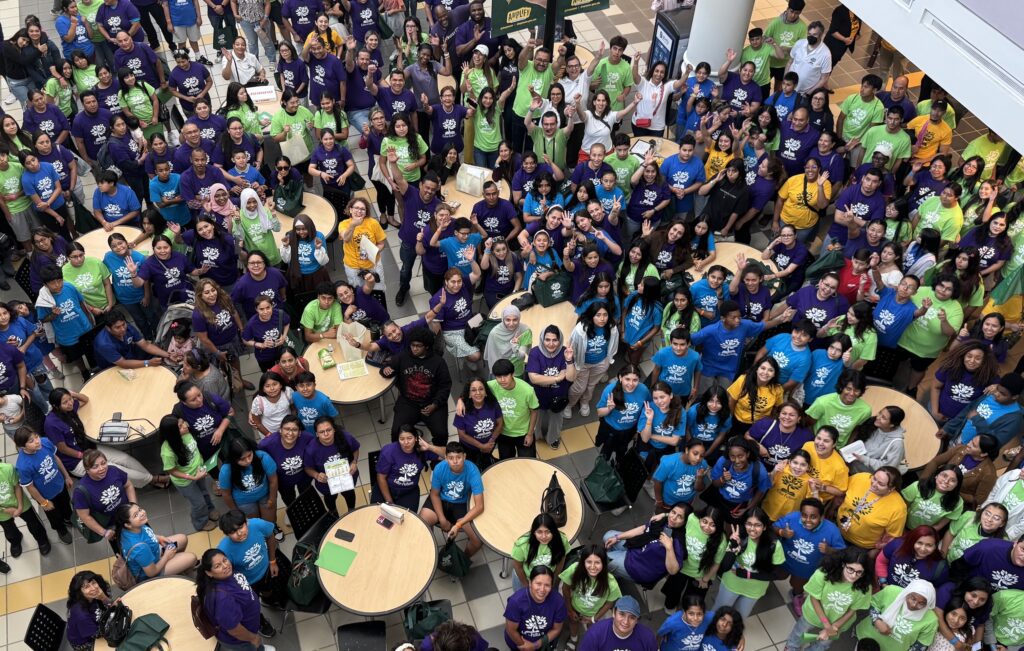
Led by our full-time Volunteer Coordinator, each year Edu-Futuro engages over 250 volunteers who provide invaluable support for our programs as workshop co-facilitators, career panelists, and mentors. Volunteers play a central role in guiding program participants along their professional journeys, particularly as mentors for the Emerging Leaders Program. We also use volunteers for one-time opportunities to serve as panelists for career exploration workshops, committee members to review applications and select recipients for college scholarships, and judges for our annual speech and essay competitions. For more information, please contact our Volunteer Coordinator, Mariana Balgurevich, at volunteer@edu-futuro.org, or consult our volunteer registration form.
How are charitable dollars spent? Where does my donation go?
Generous donations made to Edu-Futuro are what allow us to provide our services to nearly 5,000 students and parents each year. It is important to note that about 75% of the funds we receive through grants and contracts each year are earmarked for specific programs, and do not cover critical operating and administrative expenses. Unrestricted funds like those we raise from individual donors help give us the capacity and flexibility we will need to meet our ambitious goal of serving more than 5,400 unduplicated individuals in Fiscal Year 2025-2026 — and to strengthen our organization to face new challenges in the years to come.
More than anything, your support can help change the lives of young people like Eric Pleitez, an Emerging Leaders Program graduate who went on to earn his both a Bachelor’s and Master’s degree in Finance from the George Washington University. Eric recently shared a testimonial with us that can be viewed here: https://youtu.be/MvGkh4PLCMY
Information provided March 2026
Centro de Apoyo Familiar
 Centro de Apoyo Familiar
EIN: 26-0452137
Mission Statement
Transform communities through economic, social and educational empowerment in collaboration with community and faith-based organizations.
Program Summary
Centro de Apoyo Familiar (CAF) is a 501(c)(3) not-for-profit organization dedicated to transforming communities through economic, social, and educational empowerment in collaboration with community and faith-based organizations. As a HUD-approved Housing Counseling Agency, CAF provides free educational workshops and a wide range of housing counseling services, including pre-purchase assistance, foreclosure prevention, and rental guidance. Founded in Massachusetts in 2006 and expanded to Maryland, Northern Virginia, Washington, D.C., and Puerto Rico, CAF’s Community Transformation Model offers comprehensive support through food distribution, environmental health and justice, workforce development, and housing opportunities. Serving over 55,000 low-income and immigrant families each year, CAF is committed to building stronger and more resilient communities.
Impact Statement
Through its services and programs, Centro de Apoyo Familiar reached and impacted over 25,000 low to moderate-income families annually. Specifically through the programs and services listed above.
What ways can the public get involved?
We continue to encourage community involvement through offering meaningful careers, volunteer opportunities, exciting events and through donations.
How are charitable dollars spent? Where does my donation go?
CAF will use your donation to be applied to a number of the programs that CAF currently offers and that is more appealing to you. CAF also benefits from you donation to support our general operation and to build capacity in many areas of the organizations.
Information provided June 2026
Arlington Thrive
 Arlington Thrive
EIN: 51-0207684
Mission Statement
Thrive provides integrated support to our neighbors in need so they can develop the capacity to be stable, secure, and thrive in their community.
Program Summary
Early Childhood Program: These initiatives provide critical support to families with infants and young children. We understand that financial security begins with access to reliable and affordable childcare. That’s why we provide access to affordable childcare, which is crucial for parents to provide for their families and pursue educational opportunities. We also offer resources such as baby boxes filled with essential supplies for infants’ health and safety. Through our Early Childhood Programs, we also provide safe sleep and car seat trainings to equip families with the tools they need to thrive and succeed.
Community Navigator & Employment Pathways Program: These programs work together to provide tailored guidance that strengthens each client’s path to long‑term stability. Community Navigators offer short‑term case management, financial counseling, and individualized support, while Employment Pathways expands earning potential through industry‑recognized certifications, skills‑building courses, and targeted career coaching. By combining immediate support with mid‑career workforce development, Thrive empowers individuals and families to increase their income, access new opportunities, and build a more secure future.
Community Resilience Program: This program serves as a vital lifeline for individuals and families in Arlington facing severe hardships. We help families overcome immediate financial crises by providing rental, utility, and medical assistance. The Community Resilience Program also provides crucial information and referrals that are accessible to individuals and partner nonprofits. This program ensures that neighbors in need can quickly connect to the full range of support services available in Arlington, helping them access the right resources at the right time.
Impact Statement
Arlington Thrive provides financial assistance and comprehensive support services that empower families to achieve stability. This includes access to affordable childcare, financial counseling, job training, and one-on-one support to help people set goals, solve problems, and find the resources they need to achieve long-term stability. Leading with a community first approach, Arlington Thrive values meeting our clients, partners, and supporters at various community events, holiday markets, fairs, and other places Arlington neighbors spend time together. By focusing on holistic support, Arlington Thrive aims to break the cycle of poverty and create pathways to prosperity for families in need.
What ways can the public get involved?
The public can get involved in Arlington Thrive’s work in several ways. Thrive is always looking for volunteers! Whether you’re a photographer wanting to gain more experience, a tech guru who can lend a hand, or someone who loves to see the day-to-day impact of Thrive’s work, we would love to have you be a part of Thrive! Another way to get involved is to amplify Arlington Thrive’s messages on social media. By sharing our posts, spreading awareness about our programs and services, and encouraging others to get involved, individuals can help increase Arlington Thrive’s reach and impact. Can’t find what you’re looking for? Visit www.arlingtonthrive.org for more information, sign up for our newsletter, and meet us at the next community event!
How are charitable dollars spent? Where does my donation go?
Charitable dollars donated to Arlington Thrive are spent on responding nimbly to community needs. These donations ensure that every local family in Arlington can not only call it home but also find a path to stability and prosperity in the community. Your donation goes towards funding urgent rent, utility, and medical needs, as well as providing infant health, safety, and wellness supplies. Additionally, donations support affordable childcare and essential job training programs. By donating to Arlington Thrive, you are directly contributing to the well-being and stability of individuals and families in Arlington, helping them overcome financial crises and build a better future.
Information provided March 2026